How to Reduce Cart Abandonment and Win Back Lost Sales
Discover how to reduce cart abandonment with our guide. Learn proven strategies, checkout fixes, and recovery tactics that turn lost carts into revenue.

If you want to learn how to reduce cart abandonment, you first have to get inside your customer's head. What makes someone who is this close to buying suddenly hit the brakes? It almost always comes down to friction—unexpected costs, a clunky checkout, or a simple gut feeling that your site isn’t trustworthy.
Nailing these core issues is the absolute first step to plugging the leaks in your sales funnel and watching your revenue climb.
Getting to the Root of Why Shoppers Leave
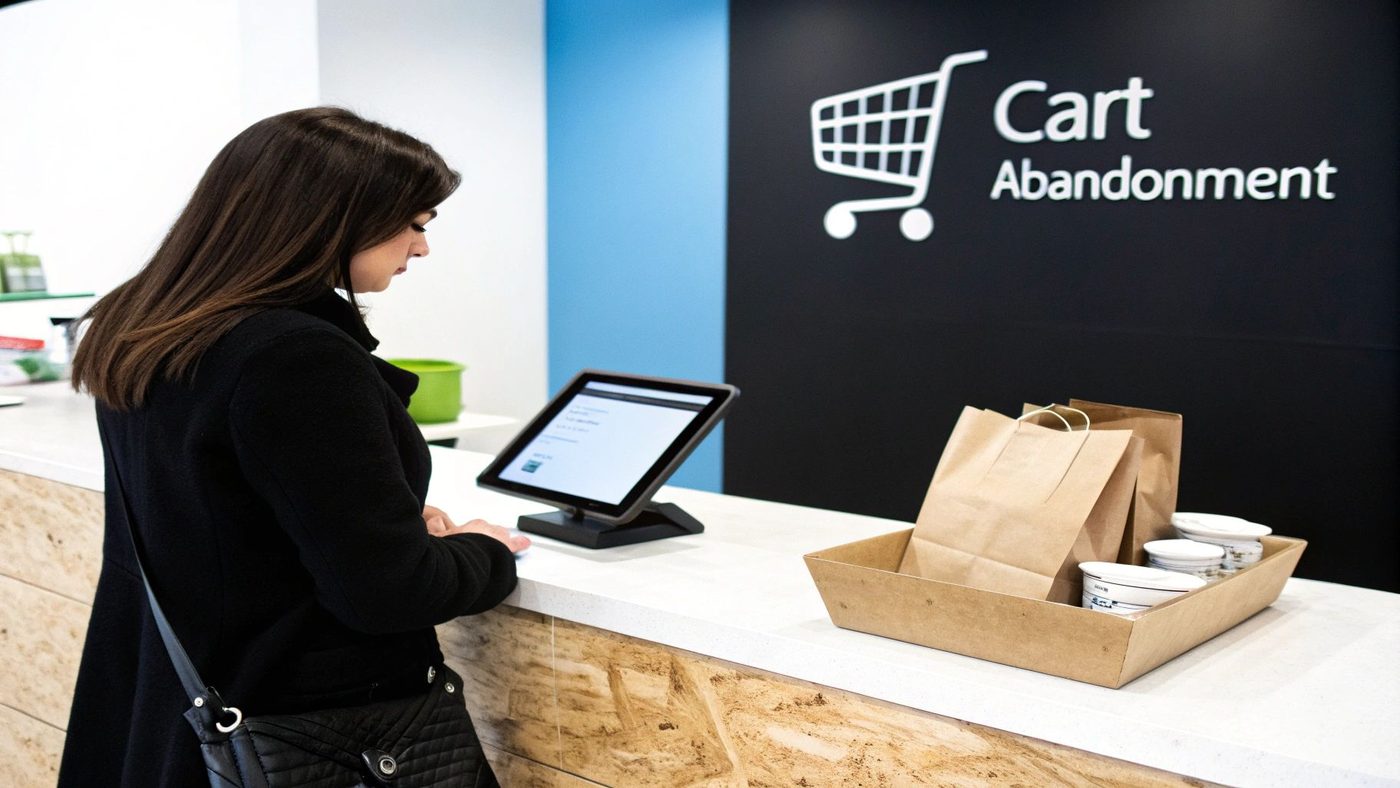
Shopping cart abandonment isn’t just some quirky online shopping habit; it's a massive hole in your store’s bucket. Think about it: every single abandoned cart is a customer who was seconds away from a purchase. They found a product they loved, added it, and started to pay... only to vanish. This isn't just a lost sale; it's a loud-and-clear signal that something, somewhere, is broken.
The scale of the problem is pretty wild. The average ecommerce cart abandonment rate across all of e-commerce is a staggering 69.99%. That translates to an estimated $4 trillion in lost sales every single year. For those of us on Shopify, it gets even more intense on mobile, where abandonment can soar to a painful 85.65%.
The Psychology of Ditching a Cart
Before you can fix the problem, you need to understand the "why." People don’t bail on their carts for no reason. Their decision is almost always triggered by a specific frustration or doubt during the buying journey. Put yourself in their shoes: they're about to hand over their credit card details. Any little thing that feels off can kill the entire transaction.
Here’s a look at the data to see what’s really going on. These are the top reasons shoppers get cold feet right at the finish line.
Top Reasons for Cart Abandonment
This table gives a quick summary of the primary reasons shoppers abandon their carts, helping you prioritize which issues to tackle first.
| Abandonment Reason | Percentage of Shoppers | Quick Fix Solution |
|---|---|---|
| Extra costs too high (shipping, taxes) | 48% | Offer free shipping thresholds; show all costs upfront. |
| The site wanted me to create an account | 24% | Enable a guest checkout option. |
| Delivery was too slow | 22% | Offer multiple shipping speeds, including express options. |
| I didn't trust the site with my credit card info | 18% | Display security badges (SSL, McAfee) prominently. |
| Too long/complicated checkout process | 17% | Simplify your checkout to a single page; reduce form fields. |
The main culprits are clear. Things like sticker shock from unexpected fees and forcing someone to create an account are massive conversion killers.
The core takeaway is this: Cart abandonment isn't the problem itself—it's a symptom of a deeper issue in your customer experience. By finding and fixing these root causes, you can stop leaking revenue and turn more browsers into loyal buyers.
For a deeper dive into this widespread issue and how to fix it, there are some great strategies to reduce cart abandonment and boost sales that can help you get started.
Make Your Checkout Experience Effortless
Before you even start thinking about recovery emails, you have to stop pushing customers away in the first place. A clunky, confusing, or untrustworthy checkout is the single biggest reason people ditch their carts. Think of it as the final handshake—if it's awkward or weak, the whole deal falls through.
The mission here is to make buying from your store feel completely seamless and secure. Every extra click, every surprise fee, every moment of hesitation adds friction that can kill a sale instantly. Let's plug these leaks, starting with the biggest culprits.
Get Rid of Sticker Shock with Full Transparency
The number one reason shoppers leave is being slapped with unexpected costs right at the end. That $49 product suddenly jumping to $65 after shipping and taxes feels like a classic bait-and-switch, and it shatters trust.
You have to be radically transparent from the get-go. Show shipping costs, taxes, and any other potential fees directly on the product page or in the cart—long before they hit the final payment screen.
Here’s how you can do that:
- Add a Shipping Calculator: Pop a simple tool on your cart page where customers can enter their zip code to see shipping estimates upfront. No more guesswork.
- Promote Free Shipping Thresholds: Make a clear banner in your site's header that says something like, "Free shipping on all orders over $75!" This not only clarifies costs but also nudges people to spend a little more.
- Be Upfront About Fees: If you have to charge a handling fee, explain what it’s for. Honesty builds trust, even when you're adding a small charge.
Clear the Path to Purchase
A complicated checkout process is a conversion killer. People expect speed and simplicity. Forcing them to create an account or fill out a dozen form fields is a great way to send them running to a competitor.
One of the single most powerful changes you can make is to offer a guest checkout option. Research consistently shows that forced account creation is responsible for a whopping 24% of abandoned carts. Just let people buy the thing.
A huge part of this is having an ecommerce website design for high conversion that guides the user, not obstructs them.
Take a hard look at your checkout form and be ruthless. Do you really need their phone number right now? Can you use an app to auto-populate their address? Every field you eliminate is one less reason for them to give up.
Build Unshakeable Trust and Credibility
The moment a customer pulls out their credit card, they’re placing a massive amount of trust in your store. You need to constantly reassure them that their information is safe and their purchase is protected. This is where trust signals come in.
Essential Trust Signals to Add to Your Checkout:
- Security Badges: Place logos from McAfee, Norton, or your SSL provider right near the "Complete Purchase" button. This is where anxiety peaks, and seeing those logos can be incredibly reassuring.
- Payment Logos: Show that you accept major players like Visa, Mastercard, PayPal, and Apple Pay. Familiarity breeds comfort.
- Customer Reviews: A few positive star ratings or a short testimonial visible during checkout can provide that final nudge a hesitant shopper needs.
- A Clear Return Policy: Make sure you link to a simple, fair return policy. Knowing they can easily send something back removes the risk from the buying decision.
Nail the Mobile Checkout Experience
Most of your customers are probably shopping on their phones, so a clunky mobile checkout is simply not an option anymore. What works on a desktop can be an absolute disaster on a small screen—think tiny buttons, endless scrolling, and squinting to read the text.
Your mobile checkout has to be designed for thumbs. That means big, easy-to-tap buttons, large form fields, and as little typing as possible. Integrating mobile-native payment options like Apple Pay, Google Pay, and Shop Pay for one-tap purchasing is a game-changer.
By focusing on transparency, simplicity, trust, and a flawless mobile experience, you create a frictionless path to purchase. You'll stop losing easy sales and start building the kind of trust that turns first-time shoppers into loyal customers.
Turn Window Shoppers Into Leads Before They Vanish
Let's be realistic: even with the smoothest checkout process in the world, some shoppers simply won't be ready to buy on their first visit. They might be comparing prices, saving ideas for a birthday, or their cat just walked across the keyboard. It happens.
But a visitor leaving your site doesn't have to be a lost sale. This is where you switch from defense to offense by capturing their email before they disappear.
Getting that contact information turns an anonymous browser into a real, tangible lead. You've just opened up a direct line of communication, giving you a chance to bring them back. It’s always easier to win over a warm lead who has already shown interest than to start from scratch with a cold one.
The Power of a Well-Timed Pop-Up
I know, the word "pop-up" can conjure images of those awful, spammy ads from the early 2000s. But modern pop-ups, when used strategically, are one of the single most effective tools for growing your email list. The entire game is about providing genuine value at just the right moment.
Your pop-up needs to be more than a lazy "Join Our Newsletter." It has to be a compelling offer that makes the shopper want to trade their email for it.
Pop-Up Offers That Actually Work:
- A First-Time Buyer Discount: The classic "10% Off Your First Order" works for a reason. It immediately tackles price concerns and gives them a reason to buy now.
- Exclusive Content: If you sell something specialized, like fitness gear or high-end coffee, offer a free guide. Think "5 Exercises to Perfect Your Form" or "The Ultimate Guide to Cold Brew." It positions you as an expert.
- A Contest or Giveaway: Offering a chance to win a bestseller or a generous gift card can create a flood of sign-ups. It gamifies the experience and lowers the barrier to entry.
Think of your pop-up as a helpful store associate, not a pushy salesperson. The goal is to make an offer so timely and relevant that it feels like a friendly suggestion, not an annoying interruption.
Using Exit-Intent Technology to Your Advantage
Now for the real magic: exit-intent technology. This clever tool tracks a user's mouse movements and can tell the exact moment they’re about to leave your site—when their cursor darts up to close the tab or hit the back button.
This is your do-or-die moment. The shopper is already on their way out, so you have literally nothing to lose by making one last play.
An exit-intent pop-up is your final, best chance to stop abandonment in its tracks. Imagine a customer with $150 worth of products in their cart suddenly heads for the exit. A pop-up can appear with a tailored message: "Wait! Complete your order now and get 15% off + free shipping." That last-second nudge is often all it takes to close the deal.
Once you have their email, you can follow up with powerful, targeted messages. For a deep dive on this, check out our guide on the top automated email flows that will skyrocket your Shopify sales.
By setting up this kind of onsite capture, you're building a crucial safety net. You'll not only stop some carts from being abandoned but also build a high-value email list you can market to for months, squeezing every drop of value from your traffic.
Automate Your Recovery with a Smart Email Sequence
Alright, you've captured their email. Now it’s time to deploy your most powerful weapon against cart abandonment: the automated recovery email sequence.
This isn't about sending one generic "you forgot something" email and hoping for the best. A smart sequence is a strategic series of messages that works around the clock to gently nudge hesitant buyers back to their cart. Think of it as your 24/7 sales recovery agent, working in the background to reclaim revenue you'd otherwise lose for good.
H3: Nail the First Email: Timing is Everything
Your first email is the most important one in the entire sequence, and its success boils down to one word: speed. You absolutely need to send this message within one hour of the cart being abandoned. Any longer, and the customer's buying intent starts to fade fast.
This initial touchpoint should feel like helpful customer service, not a desperate sales pitch. Keep the tone light and friendly.
Simple, direct subject lines usually perform best here. Try things like:
- Looks like you left something behind...
- Did you have trouble checking out?
- Your cart at [Your Brand] is waiting for you
Whatever you do, don't offer a discount in this first email. You'll accidentally train your customers to abandon carts just to get a coupon. First, see if a simple, timely reminder is all it takes.
H3: Use Dynamic Content to Remind Them What They’re Missing
Here's where the magic happens. A generic email is easy to ignore, but a personalized one is hard to resist. The best way to do this is with dynamic content that automatically pulls in the exact items the shopper left behind.
Seeing high-quality images of the products they wanted creates a powerful visual reminder, reigniting that initial spark of desire.
By showing customers exactly what they’re missing out on, you transform a vague thought into a tangible, desirable product they nearly owned.
Then, make it incredibly simple for them to finish the job. Include a single, unmissable call-to-action (CTA) button that says "Return to My Cart" or "Complete Your Order." This link should take them straight back to a pre-populated checkout page, removing every bit of friction.
H3: Build a Multi-Part Flow for Maximum Recovery
Not everyone will convert after the first email, and that's perfectly fine. A well-timed, multi-email sequence can recapture a significant chunk of those who need a little more convincing. For most Shopify stores, a three-part flow strikes the perfect balance between persistence and politeness.
If you want to dive deeper into the nuts and bolts, you can find more proven strategies to recover lost Shopify sales right here.
The second email should go out about 24 hours later. This is your chance to introduce a little urgency or social proof. A subject line like "Your items are selling out fast!" can work wonders. You can also use this email to reinforce your brand's value propositions—things like free shipping, easy returns, or a satisfaction guarantee.
Your third and final email, sent 48 to 72 hours after abandonment, is your final play. If you're going to offer an incentive, now is the time. A small discount, like 10% off or free shipping, can be the final nudge a price-conscious shopper needs. Just be sure to frame it as a special, limited-time offer to encourage immediate action.
Here’s a simple blueprint you can follow to structure your own high-converting email sequence.
Abandoned Cart Email Sequence Blueprint
This table breaks down a proven 3-part email flow that balances timing, content, and persuasion to bring shoppers back.
| Timing | Content Focus | Example Subject Line | |
|---|---|---|---|
| Email 1 | Within 1 Hour | A friendly, helpful reminder with dynamic cart contents. No discount. | Your cart from [Your Brand] is waiting! |
| Email 2 | 24 Hours Later | Build urgency, highlight benefits, or include customer reviews. | Don't miss out! Your items are selling fast. |
| Email 3 | 48-72 Hours Later | Introduce a small, time-sensitive incentive like a discount or free shipping. | A special offer just for you to complete your order. |
This might sound like a lot of work, but with the right tools, it's a "set it and forget it" system.
Using a tool like Email Wiz, you can automate this entire process. AI can help you write persuasive copy, design beautiful, on-brand templates with your logo and colors, and set up the whole flow in just a few minutes. This frees you up to focus on running your business while your automated system works tirelessly to bring lost revenue back where it belongs.
Branch Out with Multi-Channel Recovery Tactics
Okay, so you've got a solid automated email sequence dialed in. That's a huge win. But what happens when emails get ignored, buried in an inbox, or sent straight to spam?
Email is your workhorse, but it shouldn't be your only horse in the race. To really make a dent in your abandonment rate, you need to meet shoppers where they are. That means thinking beyond the inbox and building a safety net that catches sales across different channels. By layering in a few other tactics, you create more opportunities to bring a customer back and remind them what they were so excited about.
Tap Into the Immediacy of SMS Recovery
Think about it: how quickly do you open a text message? Almost instantly, right? That’s why SMS is such a powerful tool for cart recovery. With open rates floating around a staggering 98%, a well-timed text can slice through the digital noise in a way email just can't.
But with great power comes great responsibility. SMS is a very personal channel, so you absolutely must have explicit consent (a clear opt-in) from your customers before you start texting them.
A few ground rules for SMS cart recovery:
- Be brief. Get straight to the point. A friendly reminder, a mention of their items, and a direct link to their cart is all you need.
- Time it right. The sweet spot is usually within the first hour of abandonment. Just be mindful of the time of day—nobody appreciates a marketing text at 2 AM.
- One and done. Unlike email, this isn't the place for a multi-message sequence. A single, well-crafted text is almost always the best approach.
Keep it simple. Something like, "Hey [Customer Name]! Looks like you left something great in your cart at [Your Store]. Your items are saved! Finish your order here: [Short Link]" works perfectly.
Use Onsite Remarketing to Greet Returning Visitors
So what about the shoppers who ignore both your emails and your texts, only to show up back on your site a few days later on their own? This is the perfect moment for onsite remarketing.
This isn't about aggressive pop-ups. It's about using subtle banners or notifications to remind returning visitors about the items they left behind. They’ve already taken the first step by coming back; your job is to give them a gentle nudge in the right direction.
By reminding returning visitors of their cart, you're doing more than just trying to close a sale. You're personalizing their experience based on their own actions, which makes them feel seen and understood.
A simple, non-intrusive sticky banner at the top of your homepage that says, "Welcome back! You still have items in your cart. [View Cart]" feels genuinely helpful, not pushy. It’s a surprisingly effective way to guide people right back into the checkout flow.
Segment Your Recovery Efforts for Smarter Results
Let's be honest: not all abandoned carts are the same. A first-time visitor ditching a $30 t-shirt is in a completely different headspace than a loyal customer leaving a $500 cart full of your best products. Sending them both the exact same recovery message is a massive missed opportunity.
This is where segmentation comes in. It’s the difference between shouting into a void and having a one-on-one conversation. By tailoring your approach, you make your message incredibly relevant and far more likely to resonate.
Here are a few powerful ways to segment your abandoned cart flows:
- First-Timers vs. Returning Customers: A newbie might need a little extra TLC to feel confident buying from you. A small welcome discount (10% off, for instance) can build that initial trust. A returning customer? They already know and love you, so a simple reminder might be all it takes.
- Cart Value: A cart over $200 is a big deal. It's worth pulling out the bigger guns, like a more generous discount or a prominent free shipping offer, to seal the deal. For smaller carts, a simple reminder often does the trick without cutting into your margins.
- Specific Products: Did someone abandon a high-margin product or one of your bestsellers? You can build a specific recovery flow for it. Remind them of its unique benefits, showcase a five-star review, or create a little urgency by mentioning it's a popular item.
By layering these multi-channel tactics, you move beyond a basic, one-size-fits-all strategy. You start building a sophisticated recovery system that adapts to your customers and works tirelessly to bring that lost revenue back home.
Measure and Optimize Your Recovery Strategy
Launching an abandoned cart strategy without tracking its performance is like sailing without a compass. You’re putting in effort, sure, but you have no idea if you’re actually getting closer to your destination. To turn your recovery efforts from a hopeful guess into a predictable revenue stream, you have to get comfortable with the data.
This is the only real way to understand what's connecting with shoppers, what's falling flat, and where the biggest opportunities for growth are hiding. A data-driven approach lets you make smart, informed tweaks that directly boost your bottom line.
Key Metrics You Must Track
Your Shopify dashboard and email marketing platform are packed with information. It's easy to get lost in all the charts and graphs, so the trick is to focus on the handful of key performance indicators (KPIs) that truly tell you if your cart recovery is working.
These are the numbers that tell the real story:
- Cart Abandonment Rate: Think of this as your baseline. It's calculated as (1 - [Total Completed Purchases] / [Total Carts Created]) x 100, and it shows you the true scale of the problem. If this number starts creeping up, it might signal a new issue in your checkout process. If it's going down, your preventative measures are doing their job.
- Email Open Rate: This one is simple: are people even opening your emails? This metric tells you if your subject lines are compelling enough to cut through the noise of a crowded inbox. If your open rates are low (anything below 20% is a red flag), it’s a clear sign you need to rethink your subject lines.
- Recovery Rate: This is the big one. It measures the percentage of abandoned carts that your automated flows successfully bring back to life. It's the ultimate report card on whether your emails and texts are actually convincing people to complete their purchase.
- Revenue Recovered: This translates all your work into cold, hard cash. Tracking the total dollar amount recovered each month proves the ROI of your strategy. It’s the number you show your boss (or yourself) to justify investing more time and resources into these efforts.
The Power of A/B Testing
Once you have a baseline for these KPIs, the real fun begins. It’s time to start optimizing, and the most effective way to do that is through A/B testing. The concept is simple: you create two versions of a single element—like a subject line—and show each version to a different group of people to see which one performs better.
The golden rule here is to only test one thing at a time. If you change the subject line and the discount offer, you'll have no idea which change actually caused the lift in performance.
A/B testing removes the guesswork. Instead of wondering what might work better, you let your customers’ behavior tell you exactly what they respond to.
Here are a few high-impact elements you can start testing right away:
- Subject Lines: Try a straightforward subject line ("You left something behind") against one that creates a bit of urgency or FOMO ("Your items are selling out!").
- Email Copy: Pit a short, punchy email against a longer one that really sells the product benefits or even includes a customer testimonial.
- Incentives: Does a 10% discount get more people back than a free shipping offer? Test them head-to-head. You might be surprised which one drives more conversions without eating into your margins.
- Timing: Experiment with the cadence of your emails. What happens if you send the first email after 30 minutes instead of an hour? Or the second email after 18 hours instead of 24? Small timing adjustments can make a huge difference.
By constantly testing and iterating, you can systematically dial in every part of your recovery strategy. This continuous optimization loop is how you turn a good recovery rate into a great one. To really level up, you can learn how to segment your email list for smarter targeting, which makes your A/B tests even more powerful and precise.
Tackling Your Top Cart Abandonment Questions
When you're dealing with cart abandonment day in and day out, the same questions tend to pop up. Let's get you some clear, practical answers based on what actually works for real Shopify stores.
How Quickly Should I Send That First Recovery Email?
Timing is everything with that first email. You want to hit their inbox within one hour of them leaving your site.
Why so fast? Because the purchase is still fresh in their mind. They were this close to buying. A friendly reminder at this moment feels like helpful customer service, not a pushy sales tactic. If you wait any longer, life gets in the way, that initial excitement fizzles out, and your recovery odds plummet.
Should I Immediately Offer a Discount?
This is a classic dilemma. Discounts are effective, no doubt, but you have to be strategic. The last thing you want is to teach your customers that the easiest way to get a deal is to abandon their cart every time.
Here’s a smarter way to play it:
- Email 1 (sent after 1 hour): Don't offer a discount yet. This is just a simple, "Hey, did you forget something?" reminder. You'll be surprised how many people convert from this alone.
- Email 2 or 3 (sent 24-48 hours later): If they still haven't bought, now's the time to sweeten the deal. A small incentive like 10% off or free shipping can be just the push they need.
This tiered approach lets you catch the easy wins first without sacrificing your profit margins.
Think of a discount as your closing argument, not your opening line. It’s there to overcome genuine hesitation, not to reward bargain hunters.
What’s a Realistic Cart Recovery Rate to Aim For?
It's always good to have a goalpost. A solid cart recovery rate to shoot for is between 10% and 15%.
If you're hitting that range, it means your strategy is working and you're successfully bringing back a good chunk of would-be lost sales. Of course, this can vary by industry, but it's a strong benchmark. The top-tier stores, those with really dialed-in, multi-channel campaigns, can sometimes even push that to 20% or higher.
Ecommerce Cart Abandonment: Conclusion
Automate your entire email marketing strategy and recover more carts on autopilot. Email Wiz sets up high-converting abandoned cart flows, welcome series, and weekly newsletters in a single click, using AI to write copy and design on-brand templates for your Shopify store. Learn more about Email Wiz.