Shopify Email List Management Done Right
Master Shopify email list management with our guide. Learn to grow, clean, and segment your list to build customer loyalty and drive serious e-commerce revenue.

Email list management isn't just about collecting addresses; it's the living, breathing process of cultivating a healthy database of people who actually want to hear from you. It’s a continuous cycle of growing your list with the right subscribers, cleaning out those who've gone cold, and organizing everyone into meaningful groups so you can send them content they'll love.
Forget thinking of your list as a static spreadsheet. It’s a dynamic tool for building real customer relationships.
Why Email List Management Is Your Shopify Superpower
For any Shopify store, your email list is one of your most valuable assets. Period. It's a direct line to your audience that you own, completely free from the whims of social media algorithms. But just having a list isn't the endgame. Shopify users email list management is what turns that simple collection of contacts into a powerful engine for growth.
Think of it this way: your email list should be like a personal address book filled with friends you know well. You wouldn't send the same generic holiday card to everyone, right? You’d write something personal. An unmanaged list, on the other hand, is like a public phone book—impersonal, full of outdated numbers, and mostly ignored. Smart management ensures you’re talking with interested "friends," not just shouting into the void.
From a Chore to a Revenue Driver
When you get list management right, the impact on your bottom line is immediate and significant. It boosts your email deliverability, jacks up your engagement rates, and protects your sender reputation with giants like Gmail and Outlook. When you consistently send relevant messages to people who want them, your emails land in the primary inbox, driving opens, clicks, and, most importantly, sales.
The proof is in the numbers. When done right, email marketing can deliver a staggering $36 for every $1 spent. And with projections showing nearly 392.5 billion emails will be sent daily by 2026, cutting through that noise with a clean, well-managed list isn’t just a nice-to-have. It’s essential for survival.
The core principle is simple: A smaller, highly engaged list will always outperform a massive, unengaged one. Quality trumps quantity every single time because you're investing your resources in people who are actually listening.
The Four Pillars of Successful Email List Management
To bring this all together, think of your email strategy as a structure built on four essential pillars. Each one supports the others, creating a foundation that's both strong and profitable for your Shopify store.
| Pillar | Objective | Key Action for Shopify Stores |
|---|---|---|
| List Growth | Attract high-quality subscribers who are genuinely interested in your brand. | Use engaging pop-ups, embedded forms on your site, and offer compelling incentives like discounts or exclusive content. |
| List Hygiene | Maintain a clean, active list to protect your sender reputation and improve deliverability. | Regularly remove inactive subscribers, fix typos in email addresses, and run suppression campaigns for unengaged contacts. |
| Segmentation | Group subscribers based on their behavior, preferences, and purchase history to send hyper-relevant content. | Create segments for VIP customers, first-time buyers, cart abandoners, and people who have viewed specific products. |
| Automation | Nurture relationships and drive sales automatically with triggered email sequences at key lifecycle stages. | Set up welcome series, abandoned cart flows, post-purchase follow-ups, and win-back campaigns. |
By mastering these four areas, you build a resilient foundation for customer loyalty and sustainable revenue. Every email you send becomes a genuine opportunity to connect and convert.
For a deeper dive into putting these principles into action, check out our comprehensive guide on Shopify email marketing.
Building an Email List People Want to Join
Your email list isn't just another marketing channel. Think of it as a community you're building, filled with your most loyal customers and interested fans. And the secret to great email list management doesn't start with fancy automations or aggressive cleaning; it starts by getting the right people to join in the first place. The goal is to build an audience that's genuinely excited about what you're doing, not just looking for a quick, one-time discount.
So many Shopify stores fall into the trap of chasing subscriber numbers over everything else. They'll hit visitors with a huge, screen-covering pop-up the second the page loads, dangling a generic 10% off coupon. Sure, this might juice the numbers for a bit, but it often attracts bargain hunters who bounce right after they buy—if they buy at all.
Instead, let's reframe this as a value exchange. You need to ask yourself: why should someone give me their precious email address? The answer has to be a lot more compelling than a small, forgettable discount. This shift in thinking is what separates a healthy, profitable email list from a dead-end one.
Go Beyond Generic Pop-Ups
Your customers are smart. They’ve seen a million pop-ups, and most have developed "banner blindness" to the same old offers. To actually get someone's attention, your sign-up forms need to be strategic, well-timed, and offer real, undeniable value.
- Exit-Intent Technology: This is a game-changer. Instead of ambushing someone mid-browse, you can set your pop-up to appear only when their cursor heads for the exit. It’s a polite, last-ditch effort to keep them around without ruining their shopping experience.
- Valuable Lead Magnets: Offer something with more substance than a simple percentage off. This could be a free guide ("5 Ways to Style Your New Leather Jacket"), early access to a new collection, or an entry into a seriously cool giveaway.
When you're putting these ideas into action, using well-designed and effective email signup forms is key to making the whole process feel easy and professional for your visitors.
Optimize Your On-Site Placements
Your website is prime real estate for growing your list, so don't put all your eggs in one pop-up basket. Weave sign-up opportunities naturally throughout your Shopify store to catch people at different points in their journey.
Think about the high-traffic spots where a sign-up offer feels like a helpful suggestion, not a distraction:
- Website Footer: This is the bare minimum. It’s a standard, expected spot for a sign-up form, and it should be on every single page of your site.
- Blog Posts: Embed a form right inside a relevant article. If someone's reading your post on skincare routines, a CTA to "Get more expert skincare tips" is a perfect fit.
- "About Us" Page: Anyone on this page is already trying to connect with your brand. It’s the ideal moment to invite them to become part of your inner circle.
Key Takeaway: The quality of a subscriber is directly tied to the value you offered to get them. Someone who signs up for an expert guide is far more invested in your niche than someone who just grabbed a discount code.
Why Quality Subscribers Matter More Than Ever
The digital world is getting ridiculously crowded. With over 4.6 billion people expected to use email by 2025 and businesses blasting out an estimated 23 billion promotional emails every single day in 2023, just getting into someone's inbox is a major win.
This incredible volume means that earning—and keeping—that spot is tougher than ever. By focusing on attracting quality subscribers from the start, you’re making sure your messages land with people who will actually open, click, and buy. That’s how you make your email marketing efforts count.
Keeping Your Email List Healthy and Engaged
Think of your Shopify users email list less like a trophy case and more like a garden. You can't just keep planting new seeds and expect a bountiful harvest; you also have to get in there and pull the weeds. This is the heart of list hygiene—a crucial practice that keeps your list clean, healthy, and full of subscribers who actually want to hear from you.
Growing your list is exciting, but its long-term health is what really protects your profitability. A bloated list filled with inactive contacts, typos, and bounced email addresses can actively poison your marketing efforts. It drags down your engagement metrics and, even worse, tanks your sender reputation.
When Internet Service Providers (ISPs) like Gmail see high bounce rates and low open rates, they see a red flag. This increases the chances of your emails landing in the spam folder for everyone, including your most loyal, ready-to-buy customers.

Performing a List Health Checkup
Regularly "weeding" your email list isn't just a good idea; it's a non-negotiable task. It ensures you’re talking to a receptive audience, which improves your deliverability and maximizes the return on every email you send. The good news is that most modern email platforms—like Klaviyo or Omnisend—automate a huge chunk of this process for you.
Here’s a breakdown of what a proper list health checkup involves:
- Removing Hard Bounces Immediately: A hard bounce is a permanent delivery failure, usually from a fake or invalid email address. These need to be removed the moment they happen to protect your sender score.
- Monitoring Soft Bounces: A soft bounce is temporary—think of a full inbox or a server that’s briefly down. If an address soft bounces several times in a row, it’s time to treat it like a hard bounce and remove it.
- Correcting Obvious Typos: Keep an eye out for common misspellings of major email domains, like "gnail.com" instead of "gmail.com." A quick fix can save a potentially valuable subscriber.
- Identifying Inactive Subscribers: This is the biggest group you'll tackle. These are folks who signed up but haven't opened or clicked an email in a while, say 90 or 180 days.
This consistent pruning of inactive and invalid contacts is what keeps your deliverability high. Neglecting it inflates your bounce rates and sinks your reputation. The challenge is compounded by the fact that 35% of US consumers have at least two email addresses, making deduplication another key task. You can find more stats on the impact of list hygiene on Omnisend.com.
To make this process straightforward, here’s a simple checklist to follow.
The Essential List Hygiene Checklist
This table breaks down the key tasks you need to perform to keep your email list in top shape. Regular maintenance prevents deliverability issues and ensures you're marketing to an engaged audience.
| Task | Frequency | Tool/Method | Impact |
|---|---|---|---|
| Remove Hard Bounces | Immediately (Automated) | Your Email Service Provider (ESP) | Prevents damage to sender reputation. |
| Manage Soft Bounces | Automated (after 3-5 bounces) | ESP suppression rules | Cleans out addresses that are no longer active. |
| Correct Typos | Quarterly | Manual scan or list cleaning tool | Recovers potentially lost subscribers. |
| Deduplicate Contacts | Quarterly | ESP feature or manual export/import | Avoids sending duplicate emails and irritating users. |
| Run Re-engagement Campaign | Every 90-180 days | Automated email flow | Wins back at-risk subscribers before removal. |
| Suppress Inactive Subscribers | After re-engagement flow | Automated ESP segment or tag | Dramatically improves open rates and deliverability. |
By turning these steps into a regular routine, you shift from simply collecting emails to actively cultivating a high-value marketing asset.
The Art of the Re-Engagement Campaign
Before you give up on a big chunk of inactive subscribers, it’s worth trying to win them back. This is where a strategic re-engagement campaign, often called a "win-back" campaign, comes in. It’s your last-ditch effort to reignite their interest.
This isn't just another promotional email; it's a direct appeal. Your goal is to get a reaction—any reaction at all. An open, a click, or even an unsubscribe confirms they’re still there. Complete silence is your cue to let them go.
Here's a simple two-email flow you can set up and automate:
- Email 1: The Gentle Nudge: Send an email with a subject line like, "Is this goodbye?" or "We miss you." Inside, remind them why they signed up in the first place (exclusive offers, new product alerts) and include a big, clear button to stay subscribed.
- Email 2: The Final Farewell: If they don’t engage with the first email, send a follow-up a week later. Be direct but friendly: "We haven't heard from you, so we'll be removing you from our list to respect your inbox." Give them one last link to opt back in.
If a subscriber ignores both emails, it's time to say goodbye. Removing them isn't a failure—it's a smart business decision. You’re refining your audience, improving your metrics, and making sure your marketing budget is spent only on people who are actually listening. That's what effective email list management is all about.
Unlocking Sales with Smart Segmentation
Sending the same email to everyone on your list is like trying to sell snow boots in Miami. It just doesn't work. The real magic in email marketing today is sending messages so perfectly targeted they feel like a one-on-one conversation. This is the power of segmentation: slicing your audience into smaller, more meaningful groups based on what you know about them.
Instead of shouting the same message at everyone, segmentation lets you whisper the right thing to the right person. It's the difference between being another brand yelling into the void and one that actually connects. The result? Marketing that feels relevant, helpful, and drives a whole lot more sales.
And in a world where 9.7 billion emails are sent in the US every single day, you have to be relevant to get noticed. With nearly 100% of people checking their email daily—and a huge chunk checking it over 10 times a day—your message has to cut through the noise. Precision is no longer a "nice-to-have"; it's a necessity. You can see just how crowded the inbox is with more stats from Omnisend.com.
Key Segmentation Strategies for Shopify Stores
For any e-commerce brand, the best data for segmentation comes straight from customer behavior. Your Shopify store is an absolute goldmine of insights just waiting to be tapped. When you connect your email platform to your store, you can build dynamic segments that update in real-time.
Here are the most powerful segments every Shopify merchant should be using right now:
- Purchase History: This is the easiest win. Grouping customers based on what they've bought (or haven't bought) opens up a world of relevant messaging. * First-Time Buyers: Roll out the welcome mat. Send them tips on using their new product, maybe a little backstory on your brand, and a special offer to get that crucial second purchase. * Repeat Customers (VIPs): These are your best people. Treat them like it. Give them early access to new collections, exclusive discounts, or a behind-the-scenes look. Make them feel special. * Lapsed Customers: Re-engage customers who haven't shopped in a while with a friendly "We miss you!" campaign. Show them what’s new or offer a compelling reason to come back.
- Engagement Level: Not everyone on your list is a super-fan, and that's okay. Segmenting by engagement helps you focus your efforts where they'll have the biggest impact and keeps your sender reputation healthy. * Highly Engaged Subscribers: These are the people opening and clicking everything. Send them your best stuff first—they've earned it. * Occasionally Engaged: This group might just need the right nudge. Try sending them your best-sellers or a limited-time offer to reignite their interest. * Inactive Subscribers: Before you scrub them from your list entirely, run them through a re-engagement campaign. It's one last chance to win them back.
Think about this: a well-segmented campaign can drive a 760% increase in revenue compared to a generic one. Why? Because you’re no longer just pushing a product; you’re solving a specific person’s problem or fulfilling a desire at the exact right moment.
Behavioral and Lifecycle Segmentation
Once you've mastered the basics, you can get even smarter by looking at how people interact with your store and where they are in their journey with your brand. This is where your email marketing goes from good to truly exceptional.
- Browsing Behavior: Someone viewed a specific product or category but didn't buy. Perfect. Send them an email featuring that exact item, maybe with some customer reviews or related products to seal the deal.
- Cart Abandoners: This is a non-negotiable for any Shopify store. Set up an automated email series to remind shoppers what they left behind. A gentle nudge, or even a small incentive, can recover a surprising amount of lost revenue.
- Sign-Up Source: Where did they come from? A pop-up offering 15% off? A download for a detailed style guide? Their origin story tells you what they care about and what kind of content they'll want to see from you next.
By putting these strategies into play, you take the guesswork out of email marketing and start building genuinely strong customer relationships. For a deeper dive, check out our guide on 10 email segmentation best practices for Shopify stores.
Putting Your Customer Journey on Autopilot
Okay, so you’ve cleaned up your list and segmented your audience. That’s the foundation. Now for the fun part: putting your email marketing to work for you, 24/7. This is where automation comes in.
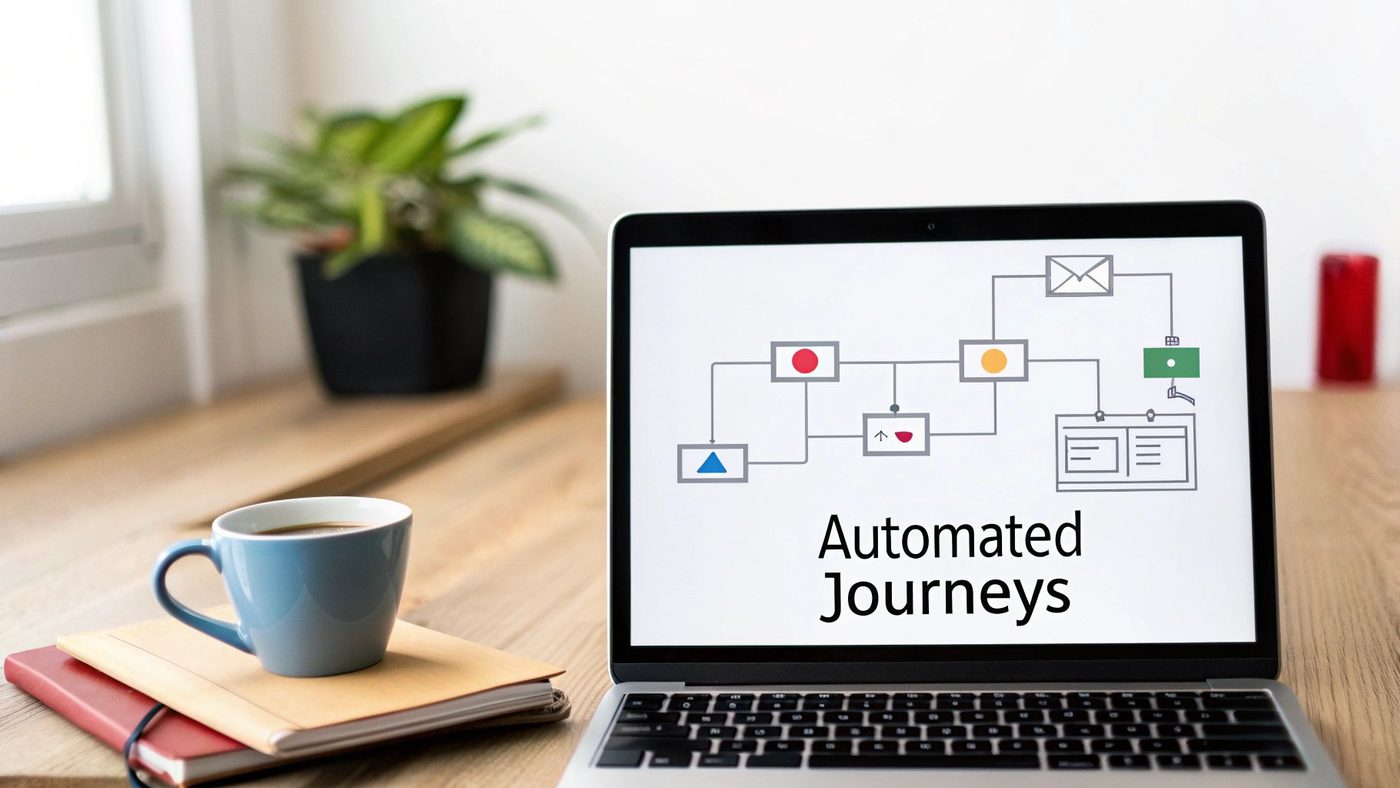
Imagine being able to personally guide every customer from the moment they discover your brand to their tenth purchase, all without lifting a finger. That’s the magic of automated email flows. They turn email list management from a chore into an engine that drives revenue while you sleep.
These aren't your average email blasts. We're talking about smart, behavior-triggered sequences that land in a customer's inbox at the exact right moment. For Shopify stores, this means creating personalized journeys that feel genuinely helpful, not robotic. The right automations can claw back lost sales, forge real brand loyalty, and turn one-time shoppers into repeat customers.
The Must-Have Automations for Every Shopify Store
While you could automate just about anything, there are a few core email flows that deliver the biggest results, time and time again. Think of these as the non-negotiables for any serious e-commerce store. They are the backbone of a solid customer lifecycle strategy and almost always outperform one-off campaigns.
The data backs this up. Brands are sending a quarter-billion more automated emails year-over-year. Welcome series saw a 2.5x jump in sends, and cart abandonment flows nearly doubled, rocking an average open rate of 42.1%.
Here are the essential automations you need to get running first:
- The Welcome Series: This is your digital handshake. Sent right after someone subscribes, this 3-5 email sequence is your chance to make a killer first impression. Use it to tell your brand story, set expectations, and gently guide them toward that first purchase.
- The Abandoned Cart Flow: We've all done it—added something to our cart and then gotten distracted. This 2-3 email series is the perfect nudge. It automatically reminds shoppers about the items they left behind, using social proof, FAQs, or a friendly prompt to get them back to checkout.
- The Post-Purchase Follow-Up: The relationship doesn’t end when the credit card is charged. A thoughtful post-purchase flow confirms their order, says thank you, and—critically—asks for a review. This builds trust and gets you that all-important user-generated content.
Building Journeys That Feel Personal
The secret to great automation is making it feel completely human. Nobody wants to be marketed to by a robot. Your goal is to anticipate what a customer needs and deliver real value at every stage, turning an automated email into a genuine moment of connection.
Key Takeaway: An effective automation isn't just about sending an email; it's about continuing a conversation that the customer already started with their actions on your site.
Getting this right comes down to timing and content. For example, your first abandoned cart email should probably fire within an hour. The second might wait 24 hours. The content should also evolve, moving from a simple reminder to highlighting product benefits or showing off five-star reviews. For a look at how this scales, it's interesting to see how agencies build a profitable email marketing service for e-commerce agencies using these same principles.
By mapping out these critical touchpoints, you put your customer relationships on a reliable, automated footing, ensuring no one ever falls through the cracks. If you're ready to dive in, our guide can help you build your first marketing automation workflow step-by-step. It’s this kind of proactive engagement that truly sets thriving brands apart.
Playing by the Rules and Keeping Score
Great marketing isn't just about creativity; it's about respecting your audience and measuring what works. When it comes to managing your email list, this means two things: playing by the rules and knowing what success actually looks like.
First, you have to stay compliant with email laws. This isn't just bureaucratic red tape—ignoring it can lead to massive fines and completely tank your sender reputation, making it impossible to even reach the inbox. Regulations like the CAN-SPAM Act in the U.S. and GDPR in Europe are there to protect consumers, and they set very clear guidelines for sending commercial emails.
For anyone running a Shopify store, the big takeaway is being upfront about consent. You can only send marketing emails to people who have explicitly said "yes," usually by ticking a box at checkout. Sneaking people onto your list is the fastest way to get your emails marked as spam.
Your Quick Compliance Checklist
Staying on the right side of the law is simpler than it sounds. It really just comes down to being transparent and respecting your subscribers' choices. Following these rules isn't just about avoiding penalties; it’s about building a brand that people trust.
- Get Explicit Consent: Never, ever add someone to your marketing list unless they've clearly agreed to be there. That opt-in checkbox on your Shopify checkout page? It's non-negotiable.
- Make Unsubscribing Easy: Every single marketing email you send must have a clear, easy-to-find unsubscribe link. Hiding it in tiny font at the bottom is a huge no-no.
- Honor Opt-Outs Immediately: When someone clicks unsubscribe, they need to be removed from your list right away. Thankfully, modern email platforms like Klaviyo or Omnisend handle this for you automatically.
- Be a Real Business: Your emails have to include your business name and a valid physical mailing address. This shows you're a legitimate operation.
Think of compliance as the foundation of your relationship with a customer. You're building trust by respecting their choice to hear from you—or not. It's the key difference between a welcome message and junk mail.
Tracking the Metrics That Actually Matter
Once your compliance house is in order, you can shift your focus to performance. After all, you can’t improve what you don’t measure. Tracking a few key performance indicators (KPIs) is how you figure out what your subscribers respond to, refine your strategy, and ultimately prove that your email efforts are making money.
These numbers tell the story of every campaign, from the moment someone sees your subject line to the instant they click "buy."
- Open Rate: The percentage of people who actually opened your email. If this number is low, your subject lines might be falling flat, or you could be sending emails at the wrong time.
- Click-Through Rate (CTR): Of the people who opened your email, what percentage clicked on a link? This metric tells you if your message, offer, and call-to-action were compelling enough to get a reaction.
- Conversion Rate: The holy grail. This is the percentage of people who clicked your email and went on to make a purchase. This is the ultimate proof that your email drove a sale.
- Unsubscribe Rate: The percentage of subscribers who opted out after getting an email. A small, steady trickle is normal, but a sudden spike is a major red flag that your content isn't resonating.
Your Shopify Email List Questions, Answered
Let's dive into some of the questions that pop up most often when Shopify merchants start getting serious about email. Think of this as your practical FAQ for putting these strategies into action.
How Often Should I Clean My Email List?
A good rule of thumb is to do a deep clean of your email list every 3 to 6 months. This means you'll run a re-engagement campaign to try and win back subscribers who haven't opened or clicked anything in that period. Anyone who still doesn't engage gets removed.
That said, some cleaning should be happening automatically. Your email platform, for instance, should be set up to immediately remove any "hard bounces"—emails that permanently fail to deliver. This is a non-negotiable step for protecting your sender reputation and keeping your list healthy from day one.
What Is a Good Open Rate for an Ecommerce Store?
For general e-commerce campaigns, seeing open rates somewhere between 15% and 25% is usually a sign you're on the right track. But honestly, the most important metric is your own trend line. Are your numbers going up or down over time?
Keep in mind that not all emails are created equal. Your automated flows, like the welcome series or abandoned cart reminders, should have much higher open rates—often hitting the 30-50% range. They're sent in response to a specific customer action, so they're highly relevant. If your regular newsletters are consistently dipping below 15%, it’s a clear signal to rethink your subject lines, segmentation, or list hygiene.
Can I Add All Shopify Customers to My Marketing List?
This one is a hard no. You can only send marketing emails to customers who have given you explicit consent to do so.
During Shopify checkout, customers see a little checkbox to opt-in for marketing. If they check it, you're good to go. If they leave it blank, you can only send them transactional emails related to their purchase (like order confirmations and shipping notifications).
Dumping everyone onto your marketing list is a fast track to violating privacy laws like GDPR and CAN-SPAM. It will get you marked as spam, wreck your deliverability, and destroy the trust you're trying to build. Always respect their choice.
Ready to automate your entire Shopify email strategy in seconds? Email Wiz uses AI to build, design, and schedule your welcome series, abandoned cart flows, and weekly newsletters with a single click. Join over 10,000 brands and turn email marketing into your top revenue channel, effortlessly. Get started with Email Wiz today.