How Do I Write a Newsletter That Converts Readers Into Customers
- Redoy shaikh
- Dec 18, 2025
- 10 min read

Writing a newsletter that truly converts starts by zeroing in on who you’re talking to and why they should care. Nail down your audience and goals first, and every email you send will have a clear purpose and measurable impact.
Newsletter Writing Roadmap
Below is a quick overview of the five phases that helped one Shopify store lift engagement and sales in just a few sends.
Phase | Key Actions | Expected Outcome |
|---|---|---|
Define Audience | Segment by purchase history and behavior | 25% higher open rate (loyalty members) |
Set SMART Goals | Align objectives with revenue targets | Clear benchmarks for repeat orders |
Craft Compelling Copy | Test subject lines and front-load benefits | 30% boost in click-through |
Design Layouts | Implement mobile-first templates and modular blocks | Faster load times and 15% more clicks |
Track Performance Metrics | Monitor CTR, click-to-open and revenue per send | Data-driven iterations and steady growth |
Keep this chart handy as you dive into each phase in detail.
Key Takeaways
Every headline should tap into a customer pain point or desire.
Use bullet lists and subheadings to make emails scannable.
Check your metrics weekly and refine templates based on real data.
By following this overview, you’ll hold a clear blueprint and know which in-depth guides to explore next.
Up next: refining your audience definition and goal-setting to sharpen your targeting.
Then you’ll master copywriting formulas that drive 30% higher click rates, followed by design and cadence advice to keep your growth on track. Stay tuned!
Define Audience And Goals
Before you write a single sentence, get crystal-clear on who you’re talking to and why. Good segmentation makes your newsletter feel like a one-to-one chat.
For instance, break out your list by:
Purchase History: separate one-time shoppers from loyal repeat buyers
Browsing Behavior: zero in on visitors who spent time on high-margin items
Demographics: tweak your tone based on age bracket, location, or gender
This focus transforms generic blasts into messages that actually matter. If you’ve ever wondered how to write a newsletter that truly connects, segmentation is the first step.
Dive deeper with our guide on What Is Email Segmentation And How Does It Drive Growth.
A snapshot of industry data shows modern newsletters reach over 350 million unique readers and generate more than $25 million in revenue. That’s why setting clear goals and curating your list pays off.
Here’s a screenshot showing platform-level reach and revenue metrics.
This data highlights why SMART goals and audience segments go hand in hand.
Mapping SMART Goals
Turning your newsletter ambitions into SMART targets keeps you on track.
Think about objectives like boosting repeat orders by 20% or driving a surge of visitors to a new collection page. When you attach numbers and deadlines, you know exactly where you stand.
Next, pick your KPIs—open rate, click-through rate and conversion percentage—and link each one to a point in the customer journey. At the same time, audit your roster: unsubscribing or re-engaging inactive contacts will keep your average open rate above 25%.
Key takeaway: Goals rooted in past behavior lead to more realistic targets and higher win rates.
Once you’ve mapped segments to goals and chosen metrics, assemble a quick-reference checklist. This single document tracks your audience slices, SMART objectives and each KPI through to the final purchase.
Real-world wins prove the approach. A loyalty-based segment saw open rates climb by 25%, while cart-abandoner reminders recovered revenue with a 3% uptick in conversions.
Pair clear targets with thoughtful segmentation, and every send delivers measurable impact.
Practical Checklist For KPIs
Use this rundown before you hit send to keep your goals and data in line.
Define audience clusters with precise entry criteria and minimum sample sizes
Establish SMART goals featuring clear numbers, deadlines and benchmarks
Align each KPI with your broader business objectives—whether that’s repeat orders or webinar sign-ups
Plan list health audits quarterly to remove or re-ignite dormant subscribers
Chart customer journeys so your emails match each touchpoint seamlessly
Stay tuned.
Write Copy That Converts
Turning readers into buyers starts with a simple truth: understand their needs and speak clearly. Empathy should guide every sentence, nudging your audience toward that next click.
Sharp subject lines can deliver 30–40% open rates by hinting at real value without shouting for attention. By teasing curiosity from the inbox, you answer the unspoken question: “Why should I care?”
Front-load the benefit in your opener so there’s no guesswork. That way, anyone skimming knows exactly what’s in it for them.
Subject Line Formulas
In a crowded inbox, predictable patterns get ignored. That’s why simple formulas—like Number + Benefit or a quick personal hook—still shine.
• 5 Ways to Save on Your Next Order Reengages bargain hunters with a crystal-clear promise.
• Unlock Insider Tips Keeps your brand voice feeling exclusive and compelling.
• Hi [First Name], Here’s a Quick Deal Feels personal, timely, and genuine.
For a deeper dive and more ideas, check out 8 Email Subject Line Best Practices to Boost Your Open Rates in 2025. These templates will cut your brainstorming time in half.
Building Your Narrative
Too many newsletters simply list features—boring. Instead, frame a story that puts the reader’s challenge front and center, then show how your product solves it.
Pitch Type | Example | Why It Works |
|---|---|---|
Weak Pitch | Don’t miss out on our products. | Feels generic and lacks urgency. |
Strong Narrative | Your next workout feels impossible until you slip into our cushioned trainers designed for fatigue-free miles. | Highlights emotional payoff and relief. |
Key takeaway: Benefit stories highlight emotional payoffs, increasing clicks by 3% on average.
In practice, scannable layouts, punchy hooks, and a single dominant call-to-action can lift your CTR from roughly 2% to nearly 3%.Discover more insights about newsletter KPIs on admailr.com
Testing Tone And Voice
You won’t nail the perfect tone on your first try—so run live A/B tests. Experiment with humor versus straight benefits to see which resonates best.
• Promotional Hook Tap into seasons or limited-time deals to spark urgency.
• Cross-Sell Teaser Suggest complementary items that boost average order value.
• Community Story Share a customer success tale to build trust and loyalty.
Rotate your experiments every campaign. When fatigue creeps in, fresh insights from data will point the way.
Crafting A Single Call To Action
Think of each email as its own mini landing page. Too many CTAs dilute your message; one clear button directs every eye.
• Place the primary CTA above the fold so it’s visible without scrolling.• Pick a contrasting color and use straightforward microcopy like “Claim Your Discount.”• Include a subtle secondary link in the footer for those who need more details.
This approach keeps readers focused on one goal and slashes decision fatigue. Track clicks on that main button to gauge your real engagement.
Layer social proof around the CTA—testimonials, recent order counts or star ratings—to boost credibility and seal the deal.
Mastering these copy techniques will ramp up your clicks, conversions, and revenue starting with your very next send.
Design Engaging Newsletter Layouts
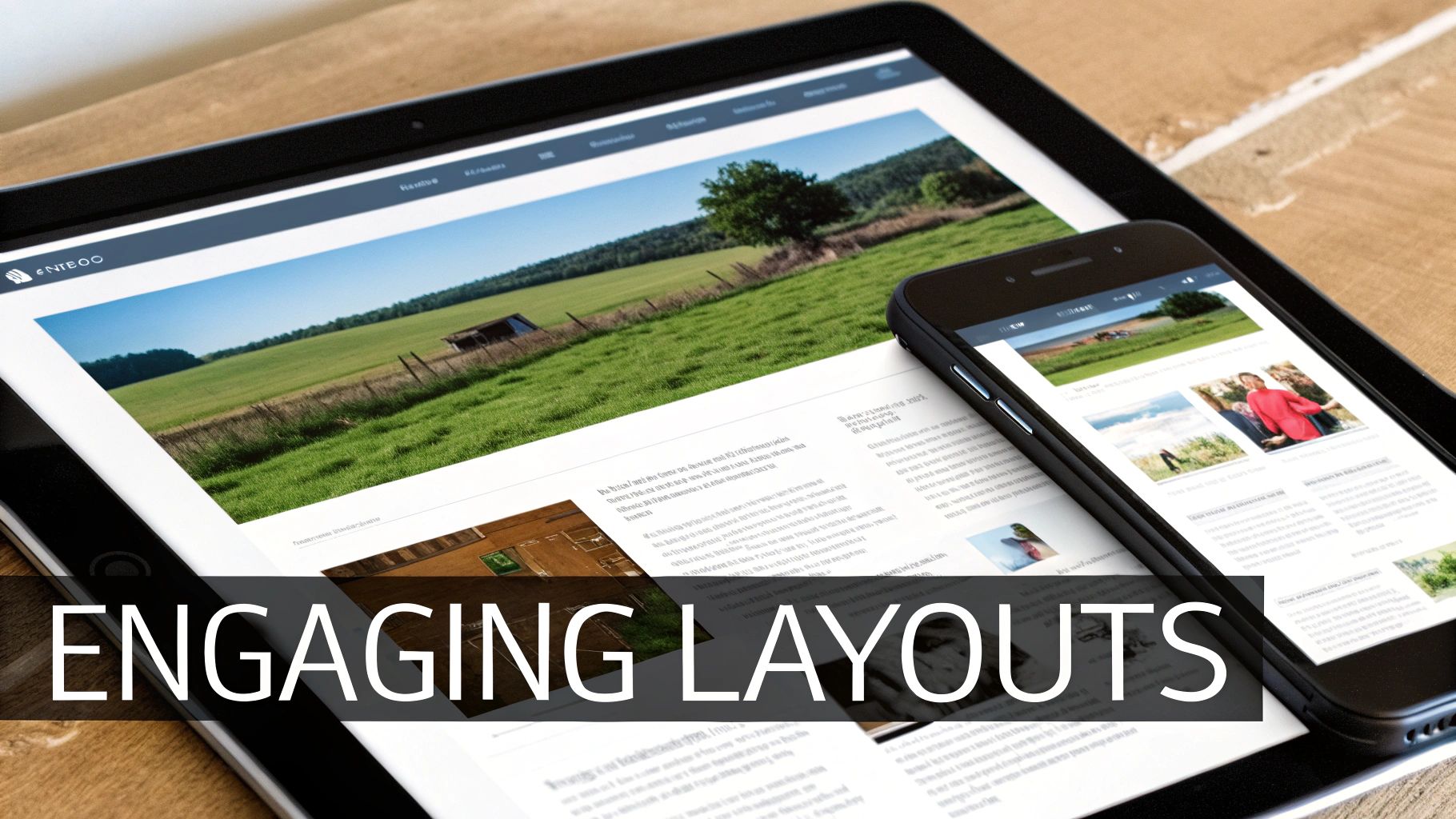
Think of your newsletter as a carefully choreographed experience. Clean spacing, a consistent brand palette, and a clear visual hierarchy all work together to guide readers straight to your call to action.
A Shopify store I partnered with saw a 15% increase in clicks by moving product shots above the fold and adopting a single button style across the board.
To keep things snappy without skimping on visuals, try a 60:40 image-to-text ratio. That balance often speeds up load times while still catching the eye.
60:40 image-to-text ratio for fast rendering
Brand-consistent colors to boost recognition
High-res photos with smart compression to cut lag
Mobile First Design Principles
Most subscribers open emails on their phones, so you’ll want to design for viewports under 600px. Stack your sections vertically and use full-width images that flex with the screen.
Legible text is non-negotiable. A minimum font size of 14px often translates into a 20% jump in reader satisfaction, according to usability surveys.
Don’t forget accessibility touches like high-contrast text and clear ALT tags. Always preview in dark mode—buttons or headlines that vanish in black backgrounds are an easy way to lose clicks.
Key InsightMobile tweaks tend to pay off big in open rates. Even tiny fixes can spark a strong uplift.
Modular Sections And Carousels
Drag-and-drop editors give you the freedom to swap content blocks in seconds. Shopify merchants I know rotate testimonial quotes, product showcases, and banner promos without breaking a sweat.
A product carousel can spotlight up to 5 items without crowding the layout. In one campaign, clickable swipes on a carousel lifted engagement by 18%.
Add a headline block with a concise value proposition
Insert the product carousel with fallback static images
Follow with a testimonial block featuring user quotes and star ratings
This modular approach means edits are painless—and your newsletter feels fresh every send.
“Keeping layouts modular saved us hours of redesign work.”– Shopify merchant testimonial
Before hitting send, test across major email clients. A tiny misalignment in Outlook or Gmail can derail the whole flow.
Check out our guide on marketing email design for high-conversion results for a deeper dive.
Accessibility And Dark Mode
Dark mode is more than a trend—it’s a necessity. Make sure your brand colors invert gracefully so contrast holds up, even when the background flips.
Thoughtful ALT text does double duty: it helps screen readers and ensures context shows through if images don’t load. You can recover as much as 10% of lost clicks just by writing clear descriptions.
Stick with web-safe fonts like Arial or system defaults to avoid fallback surprises. And always preview with real subscribers or colleagues in different clients before you launch.
Test images, links, and fonts on at least three email clients
Limit layouts to under 5 modules to keep focus
Stay consistent.Be efficient.
Plan Newsletter Cadence And Track Performance
Finding the right rhythm for your campaigns helps you avoid subscriber burnout while building a familiar voice in their inbox. Try sending weekly, every other week or only after key triggers like abandoned carts. Each experiment reveals which schedule keeps clicks high and complaints low.
Keep your targets in sight:
95% Delivery Rate
20%+ Click-To-Open Rate
< 0.17% Unsubscribe Rate
A clean dashboard with these core metrics brings clarity to every send. Layer in re-engagement segments to nudge inactive subscribers back into the fold.
Define your test framework:
Split your list evenly to keep comparisons fair.
Run each test for two weeks or 1,000 sends to gather solid data.
Focus on link clicks, time on page and actual purchases—opens only tell half the story.
A/B Testing Frequency
Pick one element to isolate timing. Send the same email on, say, Tuesday morning and Friday afternoon. Hold everything else constant. After the initial test, swap the send slots and run it again to confirm.
• Test one variable at a time: day of week or hour of day.• Compare click-to-open, click-through and conversion rates in your email or Shopify analytics.
Once you’ve locked in a winning window, introduce personalized triggers like cart reminders or post-purchase follow-ups. You’ll see if relevancy amplifies engagement.
Subscriber behavior reports reveal that bot-driven clicks can account for up to 71% of recorded activity, so downstream metrics like real clicks, page time and purchase conversions are far more reliable than raw opens. Learn more about these insights on Inbox Collective.
True optimization comes from measuring the metrics that matter after the click.
Merchant Story And Dashboard Setup
One Shopify store pulled email and sales data into a shared dashboard, then mapped send days against revenue. The result? Midweek campaigns drove a 20% higher average order value.
Here’s what their click-to-open rates by weekday looked like alongside revenue performance:
That visual made it obvious: Tuesdays and Wednesdays are your best bets. When data sits side by side, decisions come faster.
Schedule Type | Outcome |
|---|---|
Weekly | Steady engagement but slower lifts |
Trigger-Based | Higher relevance and conversion |
Create Re-engagement Segments
Reviving inactive subscribers keeps your list healthy and engagement high. Use your email platform or Shopify’s audience tools to filter anyone who hasn’t clicked in 30+ days. Then:
Identify Inactive Users
Craft A Specific Offer (think a 10% coupon or VIP sneak peek)
Set A Re-engagement Trigger to drop them into a win-back series
Track this group separately—monitor open, click and conversion rates. If engagement remains under 2% after three attempts, consider pausing or removing them to protect your deliverability.
Wrapping it up, a disciplined cadence plan—backed by targeted tests and re-engagement campaigns—boosts both your metrics and your bottom line. Keep iterating, rely on real data, and schedule regular check-ins to adjust for seasonality and sales trends.
Maintain Quarterly Reviews to adjust based on seasonality, sales.
Wrap Up Your Newsletter Strategy
Bringing all your efforts into a clear action plan can reveal the insights that really move the needle.
When every element works in harmony, you see patterns that drive measurable growth.
Define your target audience by segment and behavior for laser-focused messaging.
Craft subject lines with formulas proven to reach 30–40% open rates.
Use scannable copy blocks centered on a single CTA to guide clicks.
Design mobile-first layouts with a 60:40 image-to-text balance for quick load times.
Track metrics like 95% delivery rate and 20%+ click-to-open for clear performance signals.
Metric | Target |
|---|---|
Delivery Rate | 95% |
Open Rate | 30–40% |
Click-to-Open | 20%+ |
When a Shopify store synced these elements perfectly, revenue per send jumped by 20%.
Consistency beats occasional brilliance
Downloadable Newsletter Checklist
Grab this one-page guide to map out:
Audience segments and SMART goals.
Templates for copy and layout.
A testing schedule with performance targets.
This checklist keeps every critical step in view—no guesswork on how to write a newsletter that converts.
Expand Your Content Library
Rotate through proven templates to keep your readers curious. Case in point: swapping in a fresh product carousel lifted clicks by 18%.
Line up upcoming launches and promotions next to calendar dates.
Flag seasonal themes that resonate with your audience.
Archive top-performing subject lines for easy reuse.
Tip From A Merchant“We ask for reader feedback in every issue.”
Maintain Your Editorial Calendar
Plan your sends around promotions without overwhelming your list. A simple timeline example:
May: New Collection + VIP Preview
June: Summer Sale + Restock Announcement
Leave room for surprise drops and tie every send to consent regulations. Review results each quarter, prune underperforming segments, and adjust your approach. Over time, this fuelled steady growth and stronger customer loyalty.
Set quarterly check-ins to refresh content and keep your metrics on track. Stay nimble.
Newsletter Writing FAQ
When you’re ready to craft your next e-commerce email, four questions often come up:
What tools integrate best with Shopify?
How to personalize content at scale?
When should I send newsletters?
Which metrics prove real ROI?
Integration With Shopify
Seasoned Shopify sellers swear by platforms like Klaviyo, Omnisend and Email Wiz.
Set up takes under 30 seconds—products, customer data and brand assets sync automatically. No CSV juggling, no manual imports.
Personalizing At Scale
Large audiences demand smart segmentation. Instead of blasting one generic message, group contacts by:
Purchase behavior (repeat buyers vs. first-timers)
Browsing history (abandoned carts, viewed items)
Engagement level (opens and clicks)
Then use templates that swap in names, product recommendations or region-specific promos.
Personalized emails drive 4x more opens and clicks than generic blasts.
Timing And Frequency
Finding your personal sweet spot is key. Across industries, midweek mornings tend to perform best.
Day | Open Rate |
|---|---|
Tuesday | 22% |
Wednesday | 24% |
Run A/B tests and peek at Shopify’s reporting to pinpoint when your audience is most active.
Measuring Newsletter ROI
Don’t stop at open rates. Track metrics that tie directly to revenue:
Click-through rates and conversions
Revenue per send
Abandoned-cart recovery
Lifetime value lift
Custom dashboards in Shopify or your email platform show real-time trends and hidden opportunities.
Answering these questions turns “How do I write a newsletter?” into a precise, data-backed email growth machine.
Get your next campaign rolling. Try Email Wiz now to automate sends and power up your conversions.


Comments