How to Increase Customer Lifetime Value for Your Shopify Store
- Guy Williams

- Jan 23
- 13 min read
Updated: May 8
If you want to grow your e-commerce store, the fastest path is through a smart email strategy. Forget one-off sales; we're talking about a system that automatically nurtures customers at every single stage of their journey, turning them from first-time buyers into genuine brand fans. It’s about building a retention machine that runs on its own.
Why Customer Lifetime Value Is Your Most Important Metric
In a world of skyrocketing ad costs, focusing on Customer Lifetime Value (CLV) isn't just a good idea—it's a survival tactic. While everyone loves the thrill of a new customer, the real, sustainable profit comes from keeping the ones you already have. This is the fundamental shift that separates the brands that thrive from those that just scrape by.
The Soaring Cost of Acquisition
Let's be real: the acquisition game has gotten tough. Bringing in a new customer costs way more than keeping an existing one happy. In fact, customer acquisition costs have jumped by a massive 222% over the last eight years.
With numbers like that, the old "leaky bucket" model—where you just keep pouring new customers in as old ones fall out—is a guaranteed way to burn cash and stall growth. This is precisely why figuring out how to increase customer lifetime value is no longer optional. You shift your investment from chasing cold traffic to building real relationships with people who’ve already given you their trust (and their money).
Here's the stat that should convince you: Research from Bain & Company shows that just a 5% bump in customer retention can increase profits anywhere from 25% to 95%. This is the core principle of building a high-CLV business. You can dig into more customer lifetime value statistics to see just how powerful this is.
A Roadmap for Retention
Your email list is the most direct line you have to your customers, and a well-planned automation strategy is the key to nurturing those relationships and growing CLV. By matching your emails to specific moments in the customer journey, you can send messages that are actually helpful and relevant, encouraging people to come back and buy again.
This guide is your complete playbook for doing exactly that.
To kick things off, let's map out how different email strategies fit into the customer lifecycle. This table gives you a bird's-eye view of which automations to use and when.
Email Strategies Across the Customer Lifecycle
Customer Stage | Primary Goal | Key Email Automation |
|---|---|---|
New Subscriber/Lead | Convert to First-Time Buyer | Welcome Series, Browse Abandonment |
First-Time Buyer | Secure a Second Purchase | Post-Purchase Flow, New Customer Nurture |
Repeat Customer | Increase Purchase Frequency & AOV | Loyalty Program Emails, VIP Offers, Cross-Sells |
Lapsed Customer | Re-engage and Win Back | Winback Campaigns, Replenishment Reminders |
Think of this table as your foundation. Each of these automations plays a specific role in moving a customer from one stage to the next, building value and loyalty with every email sent. Now, let's dive into how to build each one.
Build Your Foundation with Smart Segmentation
Before you can even think about boosting customer lifetime value (CLV), you have to know who you’re talking to. Blasting the same generic email to your entire list is a fast track to the unsubscribe button. The real magic happens when customers feel like you get them, and that starts with smart segmentation—dividing your audience into smaller, more meaningful groups.
Forget just splitting your list by gender or location. The most powerful segmentation is rooted in what your customers actually do. When you send emails that reflect their actions, you build trust, drive repeat purchases, and watch your CLV climb. This isn't just a tactic; it’s the bedrock of any solid retention strategy. You can dig deeper into advanced audience segmentation strategies to really get this engine humming.
Go Beyond the Basics with Behavioral Segments
So, how do you put this into practice? Let's talk about a few high-impact behavioral segments you can build right now. These groups let you send messages that feel less like a sales pitch and more like a helpful conversation.
Purchase History: This one is gold. Group customers by what they’ve bought in the past. For instance, pull a list of everyone who bought your best-selling face wash but not the matching moisturizer. That’s a perfect, low-pressure opening for a cross-sell email.
Browsing Activity: What about the window shoppers? Create a segment for people who viewed a specific product page multiple times but never added it to their cart. A timely, gentle nudge showcasing that product’s best reviews or features could be all it takes to close the deal.
Email Engagement: Not all subscribers are created equal. Segment your most active fans—the ones who open and click on everything—and make them feel special with early access to new drops or exclusive discounts. For the less engaged crowd, a different approach is needed to win them back. For a full breakdown, check out our guide on how to https://www.emailwiz.ai/post/how-to-segment-email-list-drive-growth-with-smart-segmentation.
Identify Your Most Valuable Customers
One of the smartest things you can do with segmentation is separate your VIPs from the one-and-done discount hunters. This is absolutely critical for focusing your energy where it will have the biggest impact on CLV.
By understanding the difference between your ride-or-die fans and casual shoppers, you can tailor your efforts. VIPs get the white-glove treatment, while discount seekers might get alerts about flash sales or value bundles.
This isn’t about just sending more emails. It's about starting the right conversations with the right people, which builds stronger relationships and, ultimately, more predictable revenue for your store.
Put Your Retention on Autopilot with Automated Email Flows
Once you have your customer segments dialed in, it's time to let automation do the heavy lifting. This is where you really start moving the needle on customer lifetime value. Think of automated email flows as your 24/7 sales and relationship team, working behind the scenes to talk to customers at the perfect time, without you having to click "send" every single time.
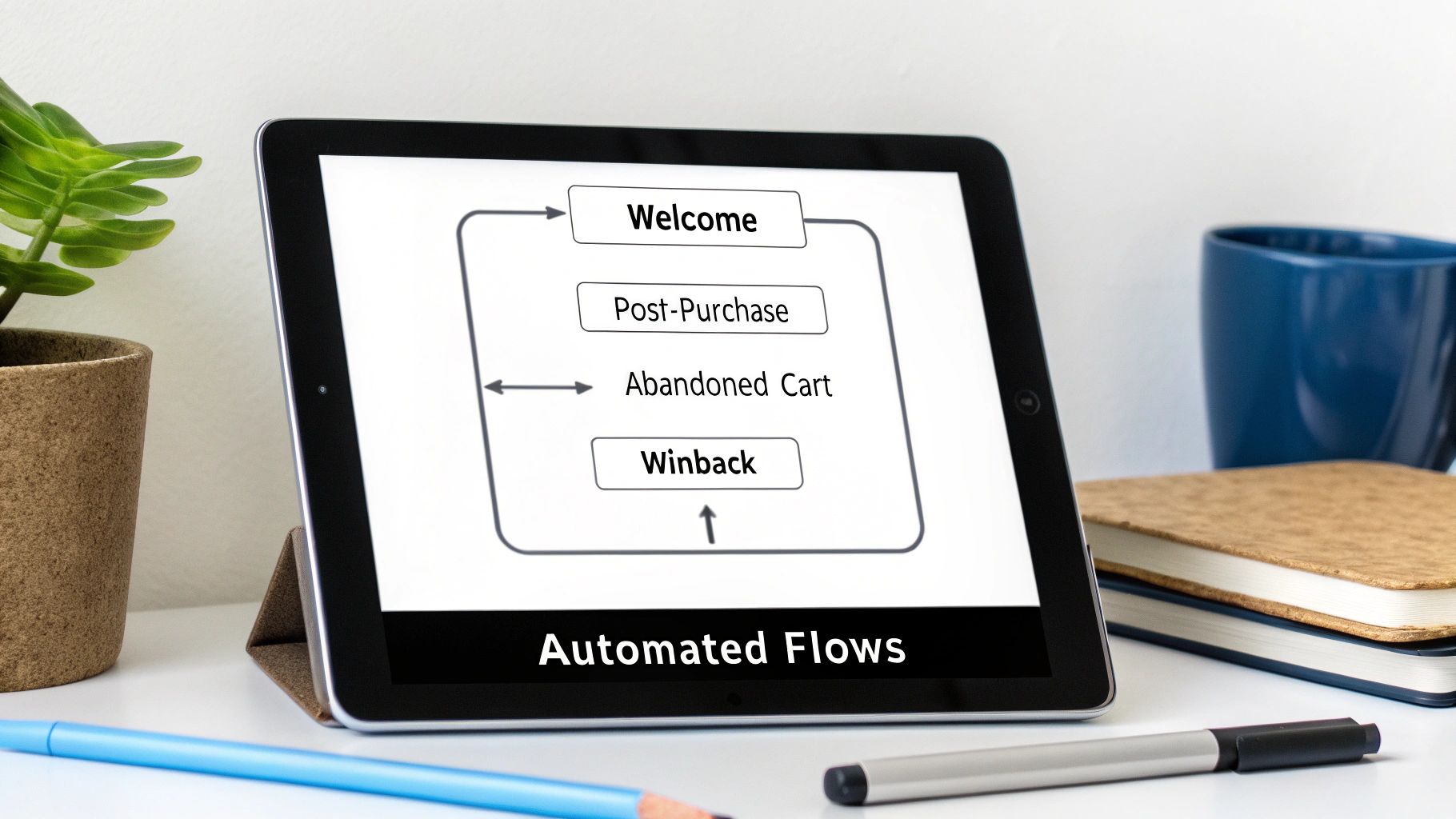
These aren’t just random emails. They are strategic, context-aware sequences that guide people through their journey with your brand. From making a knockout first impression to winning back a customer who’s gone quiet, each flow has a specific, critical job to do. Honestly, setting these up is one of the highest-impact things you can do for your store.
The data doesn't lie. We all know email marketing has an incredible return—for every $1 spent, it averages $36 back. For e-commerce, that number can soar to a 4500% ROI. But here’s the kicker: automated workflows generate 30x higher returns than one-off campaigns. That's a massive difference, making them non-negotiable for serious CLV growth. You can see more on these impressive email ROI statistics for yourself.
The Welcome Series: Nail the First Impression
You only get one chance to make a first impression, and your welcome series is it. This is about so much more than just sending a discount code. It’s your opportunity to tell your story, set the tone, and start building a genuine connection from day one. Get this right, and you'll see better engagement for the long haul.
A simple, effective structure I've seen work time and again looks like this:
Email 1 (Immediately): Deliver the goods. If you promised 10% off, send it right away. Thank them for joining and give them a quick snapshot of what your brand is all about.
Email 2 (Day 2): Tell your story. Why did you start this company? What problem are you solving? People connect with people, not faceless brands.
Email 3 (Day 4): Show them the good stuff. Highlight your best-sellers or most-loved categories. Sprinkle in some social proof like customer quotes or user-generated photos to build trust and nudge them toward that first purchase.
The Post-Purchase Flow: Secure the Second Sale
The moments right after someone buys from you are golden. They've just put their trust (and their money) in your hands. Your job now is to make them feel brilliant for doing so. A thoughtful post-purchase flow crushes buyer's remorse and smoothly paves the way for their next purchase.
This isn't about hard-selling. It's about adding value. The goal is to make the customer feel fantastic about their decision and confident in your brand. That's the foundation for repeat business.
Kick things off with a simple, heartfelt thank-you email. A few days later, send something helpful related to their purchase—maybe a "how-to" guide, care instructions, or styling tips. Later on, you can ask for a review, and after that, suggest a complementary product that makes their first purchase even better.
The Abandoned Cart Flow: Recover That Lost Revenue
Every online store deals with abandoned carts. It’s just part of the game. The good news? A huge chunk of that potential revenue is recoverable. Your automated abandoned cart flow is your single best tool for reminding these high-intent shoppers what they're missing.
Timing and tone are everything here. The first email should be a light, friendly reminder—no pressure. If they don't bite, the next email can create a little urgency or dive deeper into the product's benefits. For the stubborn ones, a small, time-sensitive offer like free shipping can be the final push they need to click "buy."
To get even more tactical with these automations, check out our deep dive into the five automated email flows that will skyrocket your Shopify sales. By putting these core flows in place, you’re building a powerful, automated engine that nurtures relationships and drives revenue around the clock.
Squeeze More Value Out of Every Sale by Boosting AOV
Getting a customer to come back is half the battle. The other half? Getting them to spend more each time they do. Pushing up your Average Order Value (AOV) is one of the most direct ways to pump up your Customer Lifetime Value (CLV).
The trick is to make your offers feel less like a hard sell and more like a helpful friend's recommendation. You have to move past generic, store-wide discounts. The AOV strategies that actually work are personal and perfectly timed, making the customer feel like you genuinely get them. This doesn't just bump up the immediate sale; it builds real trust.
Turn Post-Purchase Emails into Smart Cross-Sells
That small window right after a customer buys something? That's gold. They’re highly engaged, and their confidence in you is at a peak. It's the ideal time to suggest complementary products that make their original purchase even better.
Think about it. Someone just bought a beautiful French press from you. A few days later, you send them a friendly email with an exclusive offer on your best-selling, freshly roasted coffee beans. That’s not a pushy sales email. It’s a thoughtful suggestion that makes their morning coffee experience that much richer.
Here’s a simple flow I’ve seen work time and time again:
Email 1 (Right after purchase): The standard "Thanks for your order!" confirmation.
Email 2 (3-5 days later): A genuinely helpful email with tips on getting the most out of their new toy.
Email 3 (7-10 days later): Now, you slide in with the cross-sell. Pitch it as the "perfect pairing" to elevate what they already bought.
Get Creative with Bundles and Tiered Offers
Another fantastic way to encourage a bigger cart size is to make it a no-brainer for customers to add more stuff. You can do this with clever product bundles or by creating spending goals.
Bundles are magic when you group things that naturally go together and offer a slightly better deal than buying them separately. A skincare brand, for example, could package a cleanser, serum, and moisturizer into a "Complete Morning Routine" kit. It simplifies the decision and feels like a great value.
Strategic offers aren't just about discounts; they're about demonstrating value. When you show a customer how to get more out of their purchase—whether through a bundle or free shipping—you're building a better experience that encourages higher spending.
Tiered incentives are also brutally effective. They lay out a clear "game" for the customer to win more value, nudging them to add just one more thing to their cart to reach that next level.
You’ve seen these everywhere because they work:
Spend $75, get a free gift.
Spend $100, unlock free express shipping.
Buy 2, get 1 at 50% off.
The real beauty here is how subtle it is. You aren't just yelling, "Spend more money!" You're giving them a damn good reason to. Weaving these offers thoughtfully into your email automation is a surefire way to lift your AOV and, ultimately, get a real handle on how to increase customer lifetime value.
Turn Customers Into Fans with Loyalty Programs
Getting a single sale is one thing. Building a brand that people come back to again and again? That's where the real magic happens. Automated emails and smart offers are great for nudging individual purchases, but if you want to see exponential growth, you need to turn one-time buyers into genuine, long-term fans.
This is the point where you shift from purely transactional tactics to building an actual relationship. A well-designed loyalty program is one of the most effective ways to give customers a real reason to stick with you over the competition.
These programs are the bedrock of predictable, recurring revenue because they reward the exact behavior you want to see: repeat business. It's a fundamental strategy for increasing customer lifetime value, transforming a simple transaction into a partnership where everyone benefits.
Choosing Your Loyalty Model
Let's be clear: not all loyalty programs are built the same. The best model for your store really depends on what you sell, who your customers are, and what actions you want to encourage.
Points-Based Systems: This is the classic for a reason—it just works. Customers earn points for purchases, which they can later cash in for discounts or freebies. It’s simple, easy to understand, and directly incentivizes spending more.
Tiered VIP Programs: This approach gamifies the experience. You create different levels—think Bronze, Silver, Gold—with increasingly valuable perks at each tier. Maybe Silver members get free shipping, and Gold members get early access to new products. This creates a powerful drive for customers to spend more to unlock that next level of exclusivity.
Personalization is the secret sauce that makes these programs so powerful. It's not just a nice-to-have anymore; it's a necessity. Companies that truly nail personalization can generate 40% more revenue than average.
Look at the Adidas adiClub. Their members don't just get points; they feel like insiders. The result? They buy 50% more often, and their CLV is double that of non-members. This kind of focus on personalization has helped brands increase the value of each email subscriber by 33% year-over-year.
Launch and Nurture with Email
So, you've designed your program. Now what? Your email list is your launchpad.
Create a dedicated email flow to announce the program. Don't just say "it's here"—sell it. Clearly explain the benefits, show people exactly how to sign up, and maybe even offer a small points bonus just for joining.
Once they're in, your job isn't over. You have to keep the momentum going. Send regular updates on their points balance, create excitement by notifying them when they're close to a new tier, and send out exclusive offers that make them feel genuinely valued for their loyalty.
This consistent, helpful communication keeps your brand at the front of their minds and makes them feel like part of a club.
Another fantastic approach is the "subscribe and save" model, especially for consumable products. By offering a small discount for setting up a recurring order, you create a win-win. Your customer gets convenience and savings, and you lock in predictable revenue, directly boosting their lifetime value from day one.
Know Your Numbers: How to Measure and Optimize Your CLV Strategy
You can build the most brilliant automations and loyalty programs, but if you're not tracking what’s working, you're flying blind. It's time to put on your data hat. Don't worry, you don't need a degree in analytics—just a focus on the right numbers to see what's really moving the needle.
Measuring your efforts is what closes the loop. It transforms your email strategy from a "set it and forget it" machine into a dynamic growth engine that gets smarter and more profitable over time.
The Core Metrics That Matter
To get a true read on your store's retention health, you need to zero in on a few essential numbers. These are the metrics that tell you the real story of whether customers are sticking around and, more importantly, spending more.
Customer Lifetime Value (CLV): This is your north star. It’s the total revenue you can reasonably expect from a single customer account over their entire time with you. Everything we've discussed is designed to make this number go up.
Customer Retention Rate: This is the percentage of customers who stay with you over a given period. A rising retention rate is a direct signal that your loyalty and post-purchase efforts are hitting the mark. We've got a whole playbook on how to calculate customer retention rate for your Shopify store.
Repeat Purchase Rate: This simple metric shows the percentage of customers who have come back for a second, third, or fourth purchase. It's one of the best indicators of pure customer satisfaction.
Don’t get bogged down in the formulas. The real goal is to understand the story these numbers are telling you. See a sudden dip in your repeat purchase rate? That's a huge red flag telling you to go investigate your post-purchase experience immediately.
Get Smarter with Cohort Analysis
One of the most powerful tools in your arsenal is cohort analysis. It might sound intimidating, but the concept is actually pretty straightforward. You simply group customers together based on when they first bought from you—like your "June 2024 cohort"—and then you watch how they behave over the following months.
This is how you get real answers.
You can finally ask questions like, "Are the customers we acquired in June—right after we launched that new welcome series—spending more in their first 90 days than the customers from March?" Cohort analysis cuts through the noise and gives you a clear yes or no, proving the real-world dollar impact of your strategic changes.
Ultimately, this all comes down to a constant cycle of testing and refining. A/B test everything. Subject lines, send times, the discount offer in your winback flow, the product recommendations in your post-purchase emails. These small, iterative improvements stack up, creating a finely tuned retention strategy that squeezes every last drop of value from every customer you earn.
Burning Questions About Customer Lifetime Value
Diving into retention marketing always sparks a few questions. Let's tackle some of the most common ones we hear from e-commerce store owners trying to boost their customer lifetime value.
Should a Brand New Store Even Bother With CLV?
Yes, absolutely. Thinking about CLV from day one is like building a strong foundation for a skyscraper. Even if you only have a handful of customers, you can set up a killer welcome series and a thoughtful post-purchase follow-up.
This ensures those critical first buyers have an amazing experience, making them far more likely to come back. You’re essentially building a system that’s designed to maximize value from every single customer who walks through your digital door, right from the start.
How Long Until I Actually See Results From This?
You'll get some quick wins. Firing up an abandoned cart automation can bring in revenue literally within hours. But that's just the start. Seeing a real, meaningful jump in your overall CLV is more of a long game—it's the result of consistently building relationships.
You should start to see positive movement in your repeat purchase rates within 60-90 days after rolling out solid post-purchase and segmentation strategies. The truly game-changing CLV growth, however, unfolds over quarters and years as you successfully turn those one-time shoppers into genuine brand loyalists.
The bottom line: While some tactics deliver an instant boost, real CLV growth is a marathon, not a sprint. Consistency is everything.
Does This Mean I Should Stop Acquiring New Customers?
Not at all. Think of it less as an either/or situation and more as a balancing act. Customer acquisition (your ads, SEO, social media) and customer retention (all your CLV-focused efforts) are two sides of the same growth coin. They need each other to work.
Acquisition keeps your funnel full of fresh faces, and your retention strategy makes sure you’re not just leaving money on the table. The smartest brands use the profits from their high-CLV repeat buyers to fund new customer acquisition. This creates a powerful, self-sustaining growth loop that just keeps getting stronger.
Customer Lifetime Value Strategies: Takeaway
Ready to put your entire email marketing strategy on autopilot? With Email Wiz, you can launch a complete, AI-powered email program—from welcome series to winback flows—in just 30 seconds. See how thousands of Shopify brands are increasing customer lifetime value by visiting https://emailwiz.ai.


Comments