How to Calculate Customer Retention Rate for Your Shopify Store
Learn how to calculate customer retention rate with simple formulas and cohort analysis. Use these actionable insights to grow your Shopify store profits.

To get your customer retention rate, take your total customers at the end of a period, subtract the new customers you gained during that time, divide that by the number of customers you started with, and then multiply by 100. This straightforward formula shows you exactly what percentage of your existing customer base stuck around.
For any Shopify store, this isn't just a number—it’s a critical health check.
Why Retention Rate Is Your Shopify Store's Power Metric
Before we jump into the different formulas and spreadsheets, let’s get clear on why this metric is so incredibly important. Your customer retention rate isn't just another data point for your dashboard; it's a direct reflection of your store's health, the quality of your products, and the entire customer experience you're delivering.
Think about it this way: every dollar you spend to bring in a new customer is a sunk cost. If that customer makes one purchase and never comes back, your return on that investment is minimal. But when you get them to return, you start building a truly profitable, long-term relationship.
The True Value of a Returning Customer
A high retention rate is really the bedrock of sustainable growth. I've seen it time and time again: the stores that thrive are the ones that master retention. Loyal customers are simply more valuable than new ones.
Here’s why they pack such a punch:
- They Spend More: Customers who trust your brand come back for more. They often have a higher average order value (AOV) on their subsequent purchases.
- They Cost Less: It costs a whole lot less to convince an existing customer to buy again than it does to find a new one through paid ads.
- They Become Advocates: Happy, loyal customers are your best marketing team. They leave positive reviews and tell their friends about you—for free.
All of this feeds directly into a metric we all care about: Customer Lifetime Value (CLV). A higher CLV means each customer is generating more revenue for your business over time, giving you more cash to pour back into growth.
It’s a classic for a reason: analysis from Harvard Business Review showed that a mere 5% bump in retention can boost profits by anywhere from 25% to 95%. This isn't just a fun fact—it's your retention lifeline.
Let's put this into perspective. For most e-commerce merchants, the average customer retention rate is around 38%. This number can feel low, but it also highlights a massive opportunity. Seeing where your store stands compared to others can be a powerful motivator.
Here's a quick look at how e-commerce stacks up against other industries.
Customer Retention Rate Benchmarks Across Industries
| Industry | Average Retention Rate |
|---|---|
| Retail | 63% |
| Banking | 75% |
| Telecom | 78% |
| IT Services | 81% |
| Media | 84% |
| E-commerce | 38% |
As you can see, e-commerce has one of the lower average retention rates, which makes sense given the sheer volume of competition. This makes focusing on your repeat customers even more critical to stand out.
Turning Retention into Profit
Ultimately, knowing how to calculate retention rate gives you a powerful lever to pull for your business. If you see that rate dip, it’s an early warning that something might be off with your products, shipping, or post-purchase experience. On the flip side, seeing it climb is proof that your loyalty-building efforts are hitting the mark.
By tracking this metric, you can shift from a purely acquisition-focused mindset—which is expensive—to a more balanced strategy that nurtures the customers you’ve already won. This is where tools like automated email campaigns become so effective. You can re-engage customers at just the right moment to bring them back.
If you want to dive deeper into this, check out our complete strategy guide for maximizing Shopify store profits with automated email campaigns.
The Simple Formula to Calculate Customer Retention Rate

Alright, let's roll up our sleeves and get into the numbers. The good news? You don't need to be a data wizard to figure this out. The most common way to calculate your Customer Retention Rate (CRR) is surprisingly straightforward. All it takes is three key numbers and a simple formula.
This basic calculation gives you a fantastic snapshot of how well you’re holding onto customers over a specific period, whether that's a month, a quarter, or a full year.
Breaking Down the Formula
At its core, the formula looks like this:
CRR = [ ( E - N ) / S ] x 100
I know, I know—letters in a math formula can look a little intimidating. But each one represents a simple number you can pull right from your store's data.
Let's break down what each variable means:
- S (Start): This is the number of customers you had at the very start of your chosen time frame.
- E (End): This is the total number of customers you had at the end of that same time frame.
- N (New): This is the count of all the new customers you brought in during that period.
The whole point of this exercise is to see how many of your original customers stuck around. By taking your final customer count (E) and subtracting the brand-new ones (N), you isolate the group of loyal, existing customers who made a repeat purchase. That's the magic number.
A Practical Shopify Example
Let’s make this real. Imagine your Shopify store, "Glow Skincare," is reviewing its performance for the second quarter (April 1st to June 30th).
Here are the numbers you've pulled:
- S (Customers on April 1st): 5,000
- E (Customers on June 30th): 5,800
- N (New customers acquired in Q2): 1,200
Now, we just plug those values into our formula.
- First, let's find our retained customers: 5,800 (E) - 1,200 (N) = 4,600 returning customers.
- Next, we divide that by the number of customers we started with: 4,600 / 5,000 (S) = 0.92.
- Finally, to turn that into a percentage, we multiply by 100: 0.92 x 100 = 92%.
Boom. Glow Skincare’s customer retention rate for Q2 was 92%. That's a fantastic result, showing that the vast majority of their existing customers are happy and coming back for more.
Key Takeaway: This formula is designed to measure the loyalty of the customers you already had. It deliberately removes new acquisitions from the picture to give you a pure, unfiltered look at how well you're satisfying your established customer base.
Finding Your Numbers in Shopify
You can actually find all this data right inside your Shopify Admin—no fancy apps required. Just navigate to Analytics > Reports.
The Customers Over Time report is going to be your go-to. You can set a custom date range (like April 1st to June 30th) to see how many new and returning customers you had. This gives you your 'N' and helps you figure out 'E'. Your starting number, 'S', would simply be your total customer count from the day before your period began. It takes a tiny bit of manual work, but it’s a method every single store owner has access to.
Uncovering Deeper Insights with Cohort Analysis
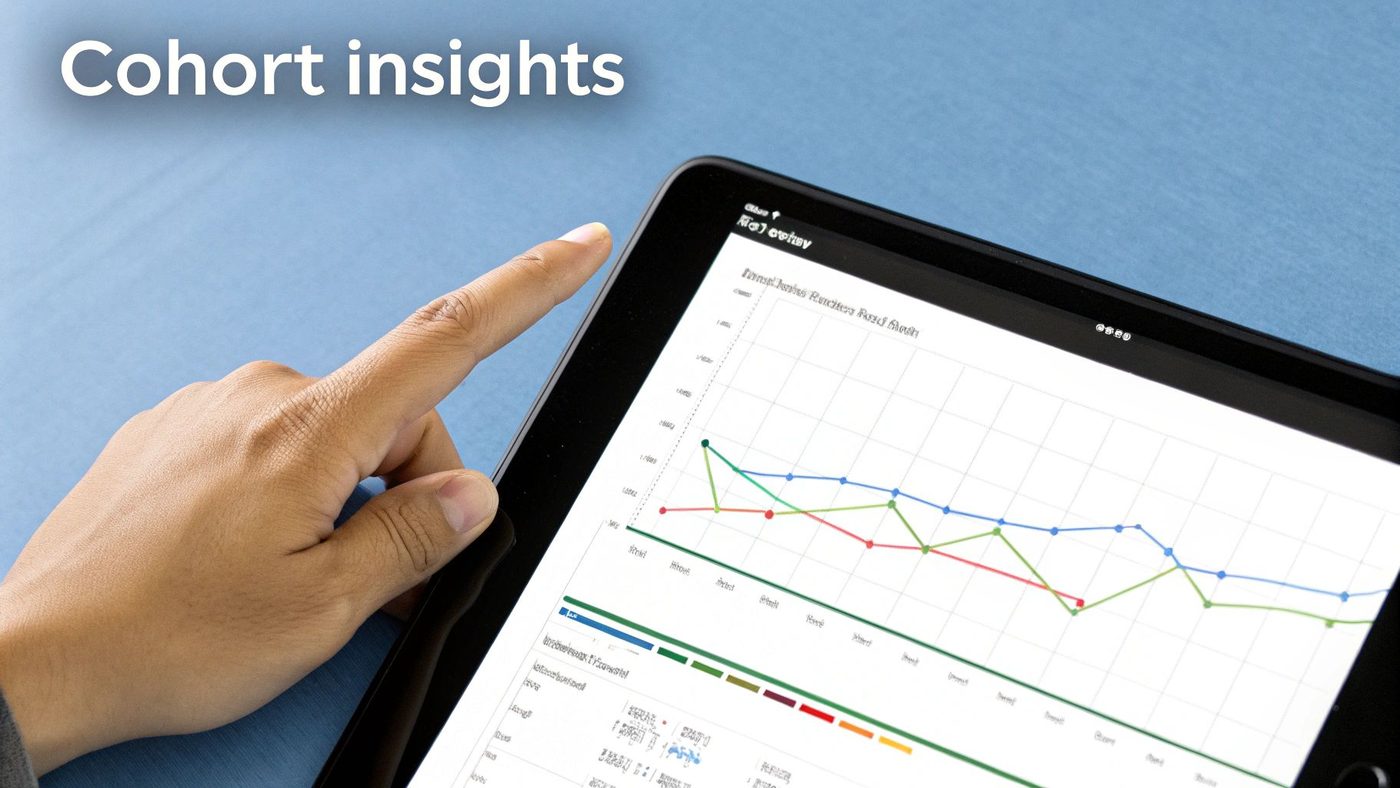
The simple customer retention formula is great for a quick health check—it gives you a single, powerful number. But imagine watching a time-lapse video of your store's health instead of just looking at one photo. That’s the power of cohort analysis.
Instead of lumping all your customers into one big bucket, this method groups them into "cohorts" based on when they first bought from you. For example, everyone who became a customer in January is one cohort, everyone from February is another, and so on.
This approach tells the story of each customer group, revealing how long they stick around. It helps you pinpoint exactly when—and maybe even why—they start to lose interest.
Reading a Cohort Retention Table
At first glance, a cohort table can seem intimidating, but it’s actually just a grid that tracks how each group of new customers behaves over time. Once you know what to look for, it's incredibly straightforward.
Let’s use our fictional "Glow Skincare" brand as an example:
| Acquisition Month | Customers | Month 1 | Month 2 | Month 3 |
|---|---|---|---|---|
| January | 1,000 | 35% | 28% | 22% |
| February | 1,200 | 38% | 31% | 25% |
| March | 1,100 | 45% | 39% | 33% |
Here’s a quick breakdown of what this table tells us:
- January Cohort: Of the 1,000 customers who first purchased in January, 35% came back to buy again in Month 1 (February), 28% returned in Month 2 (March), and 22% in Month 3 (April).
- March Cohort: Things are looking up here. Out of 1,100 new customers in March, a much stronger 45% made a second purchase in their first month.
See the trend? Retention is clearly improving with each new cohort. The group from March is much stickier than the one from January. This is the kind of insight a single, store-wide retention rate would completely miss.
This level of detail is crucial. For instance, SaaS tools often see retention drop from 39% after one month to just 30% by month three. For every 100 new customers, 70 can disappear quickly, and cohort analysis shows you exactly when to intervene. Find out more about these customer retention benchmarks on Sprinklr.com.
From Numbers to Actionable Strategy
Seeing that the March cohort performed so much better immediately begs the question: What did we do differently in March?
Maybe you launched a new post-purchase email sequence or ran a special offer for a second purchase. Cohort analysis gives you the hard data to prove that your efforts are paying off.
This also shines a light on your weaknesses. If you see a consistent drop-off across all cohorts after Month 2, you know there’s a problem at that specific point in the customer journey.
Now you can get strategic. With that knowledge, you can create targeted campaigns to re-engage customers right before that critical two-month mark. This is where creating specific segments becomes so important. For a deeper dive, learn more about what email segmentation is and how it drives growth in our guide.
Ultimately, the goal isn't just to have numbers on a spreadsheet. It's to use effective metrics and reporting to make smarter decisions that boost customer lifetime value. This deeper analysis is how you move from just calculating retention to actively improving it.
Turning Your Retention Data into Revenue
Knowing how to calculate your customer retention rate is a great start, but it's just a number. The real value comes from turning that data into a concrete plan for growth. Think of your retention stats as a roadmap—they show you exactly where and when customers are losing interest, giving you the perfect opening to step in and win them back.
This is where marketing automation really shines. Instead of manually trying to keep track of at-risk customers (an impossible task for most stores), you can build automated email flows that trigger based on specific behaviors—or a lack of them. It’s how you shift your retention strategy from reactive to proactive.
From Insights to Automated Action
Let’s say you identify that customers tend to drop off after 60 days without a purchase. With the right setup, that 60-day mark can automatically trigger a "win-back" email sequence. The first email could be a friendly "we miss you" note with a small incentive. If that doesn't work, a follow-up could showcase your latest bestsellers to spark their interest again.
But this isn’t about sending generic blasts to everyone. Smart automation is built on smart segmentation. For example, a tool like Email Wiz can analyze a customer's purchase history to send highly relevant product recommendations that feel genuinely personal and helpful, not just like another marketing email.
The data backs this up. A full 48% of business leaders see personalized outreach as a key driver for improving customer retention. And considering that 41% of accounts are lost simply due to poor follow-up, automated flows are a direct and effective solution.
Once you’ve calculated your retention rate and have a handle on your numbers, the next move is to put effective e-commerce customer retention strategies into place. The goal is to build a system that encourages repeat purchases automatically, so you’re not manually chasing every sale.
How to Fix Your Leaky Bucket with Automation
Different retention problems call for different solutions. A solid email marketing platform allows you to build targeted workflows designed to tackle the specific reasons customers leave, helping you turn one-time buyers into loyal fans.
The table below breaks down some common retention issues and shows how you can use a tool like Email Wiz to solve them automatically.
Email Wiz Automations to Improve Your Retention Rate
| Retention Problem | Email Wiz Solution | How It Works |
|---|---|---|
| First-time buyers don't return. | Post-Purchase Nurture Series | Educates customers on their new product, shares user-generated content, and introduces complementary items to build confidence and encourage a second purchase. |
| Customers forget to reorder. | Replenishment Reminders | For consumable goods, this flow predicts when a customer is running low and sends a timely reminder, making it incredibly easy for them to restock. |
| Loyal customers feel unappreciated. | VIP & Loyalty Campaigns | Automatically segments your top spenders and rewards them with exclusive access, early-bird sales, or special discounts to reinforce their loyalty. |
| Customers lose interest over time. | Win-Back & Sunset Flows | Targets customers who haven't purchased in a while with a series of tempting offers to re-engage them. If they remain inactive, it cleans them from your list. |
By setting up these kinds of systems, you're doing more than just trying to improve a metric; you're building relationships at scale. These automated touchpoints create a sense of connection and show your customers that you understand their needs and value their business.
Ready to put this into action? You can learn how to build your first marketing automation workflow in our guide. It's much simpler than you might think to get these powerful, revenue-driving systems up and running for your Shopify store.
Common Mistakes to Avoid When Measuring Retention
Calculating customer retention seems straightforward, but a few common slip-ups can give you a number that looks great on paper but doesn't actually reflect what's happening in your business. I've seen countless store owners fall into these traps, leading them to make decisions based on flawed data. Getting an accurate read on your store's health means sidestepping these common errors from the get-go.
Counting Everyone with an Email Address
One of the most frequent mistakes is lumping every single contact into your "customer" count. Let's be clear: someone who signed up for your newsletter but never opened their wallet isn't a customer you can "retain." Your calculations should only include people who have made at least one purchase.
When you include non-paying subscribers, you bloat your starting customer number (S). This artificially drags your retention rate down, making your performance look much worse than it really is. Always start with a clean list of actual, paying customers.
Picking the Wrong Time Frame
Another pitfall is choosing a time frame that doesn't fit your business model. If you sell seasonal goods like swimwear, your retention from May to June will probably look fantastic. But measure it again from August to September, and the numbers will likely paint a grim picture. The period you choose can dramatically skew your results, causing either a false sense of security or unnecessary panic.
For most Shopify stores, I've found that calculating retention on a monthly or quarterly basis hits the sweet spot. It's frequent enough to catch emerging trends but long enough to smooth out the random peaks and valleys of typical shopping behavior.
A single, store-wide retention rate can be dangerously misleading. For example, a 90% overall rate might look amazing, but it could be masking that 50% of your new customers never return. That high number could be propped up by a small group of hyper-loyal fans, hiding a serious issue with your first-time buyer experience.
Ignoring Customer Segments
Relying on a single, blended retention rate is probably the riskiest mistake of all. This one number throws everyone into the same bucket—your VIPs who buy every month, the bargain-hunters who only show up for your Black Friday sale, and brand new first-time buyers. A healthy-looking average can easily hide a "leaky bucket" where new customers are churning out as fast as you can acquire them.
To get the full story, you have to segment your customers. Digging into the data reveals what's really going on. At a bare minimum, you should be analyzing retention for distinct groups:
- New vs. Returning Customers: Are people who buy for the first time actually sticking around?
- High-Value vs. Low-Value Customers: Are you doing a good job of keeping your most profitable shoppers happy?
- Customers by Product Category: Do people who buy certain products tend to come back more often than others?
Breaking down your retention this way transforms a simple vanity metric into a powerful diagnostic tool. You can pinpoint exactly where the leaks are in your customer journey and build targeted strategies that genuinely boost loyalty.
Your Top Customer Retention Questions, Answered
Even with all the formulas and examples, I find the same few questions come up again and again. Let's tackle them right now so you can feel confident you’re on the right track with your store's retention data.
What’s a Good Customer Retention Rate for a Shopify Store?
This is the million-dollar question, and the honest-to-goodness answer is... it depends. While you might see a general e-commerce average floating around 38%, a truly "good" rate is all about your specific niche and product type.
- Consumable Goods: Selling things people use up and buy again, like coffee or skincare? A monthly retention rate of 20-30% is a fantastic sign you've built real loyalty.
- Subscription Boxes: If your business is built on subscriptions, the bar is much higher. You really need to be hitting 80% or more month-over-month to keep the model healthy and growing.
- Durable Goods: For big-ticket items with a long lifespan, like furniture or high-end electronics, a low monthly rate is completely normal. Here, looking at annual retention is what actually tells you the story.
Instead of getting hung up on a single industry number, the best thing you can do is benchmark against yourself. The real goal isn't to hit some magic percentage tomorrow. It's to see steady, gradual improvement every single quarter. That's what sustainable growth looks like.
How Often Should I Be Calculating My Retention Rate?
The key here is consistency. I've found that calculating your retention rate monthly hits the sweet spot. It’s frequent enough to see the real impact of your marketing efforts—like that new welcome series you launched—but not so frequent that the numbers are noisy with daily ups and downs.
On top of that, I always recommend doing a quarterly and annual review. These longer-term views give you that crucial 10,000-foot perspective on your store's health and help you see if you're actually moving the needle on your bigger business goals. Using a tool that can automate this reporting saves a massive amount of time and keeps these numbers front and center.
Can I Calculate This Without a Fancy Tool?
You absolutely can. When you strip it all down, the calculation only requires three pieces of data from your Shopify Admin: your customer count at the start of the period, your count at the end, and the number of new customers you brought in.
You can pull those numbers and pop them into a simple spreadsheet using the formula we walked through. While specialized tools can automate this and unlock more advanced analysis like cohorts, the core calculation is 100% accessible to every store owner, no matter your budget.
Ready to stop guessing and start growing? Email Wiz sets up your entire Shopify email channel—from win-back campaigns to post-purchase flows—in about 30 seconds. See how thousands of brands are automatically improving their retention and driving more revenue.