How to Start Email Marketing for Shopify Stores
Learn how to start email marketing for your Shopify store. This guide covers list building, automations, and growth strategies for maximum ROI.

If you're running a Shopify store, starting an email marketing program is probably the single most powerful thing you can do for your business. It gives you a direct, unfiltered line to your customers—an asset you completely own. This guide is your no-fluff playbook for launching an email program that actually makes you money, and you can get most of it done in a single afternoon.
We'll show you how to turn those one-time buyers into repeat customers for life, all without needing to hire a huge marketing team.
Why Email Is Your Most Valuable Channel
Think about it: on social media, you're at the mercy of algorithms. You post something, and you just have to hope people see it. Your email list is different. It's yours. This direct access is how you build real relationships with customers and create a reliable stream of revenue.
The numbers don't lie. Email marketing consistently crushes other channels, boasting an average ROI of $36 for every $1 spent. It’s an incredibly efficient way to grow your Shopify store, no matter your size.
This Shopify email marketing for beginners guide skips the boring theory and gets right to what works. We're not going to bog you down with jargon or complicated setups. Instead, we’ll focus on the actions that genuinely drive sales, from getting that first subscriber to creating automated emails that make you money while you sleep.
What You'll Learn
This isn't just a random list of tips; it's a complete blueprint. By the time you're done, you'll know exactly how to:
- Capture emails from the people already visiting your site.
- Automate the critical emails—like welcome messages and abandoned cart reminders—that work for you 24/7.
- Create beautiful, on-brand emails that feel professional and get people to click.
- Track the few key metrics that actually tell you if your efforts are paying off.
The goal is simple: send the right message, to the right person, at the right time. When you get that right, you've built a powerful sales engine for your store that runs on its own.
Today, AI-powered tools like Email Wiz can handle most of the heavy lifting. You can build your welcome series, set up cart recovery, and generate on-brand templates almost instantly. This is the new reality of email marketing—it’s more accessible than ever, even for a founder wearing all the hats. It's the most effective way to use email marketing to generate leads and start growing your store from day one.
Alright, let's dive in.
Building Your Foundation: The Right Tools and a Growing List
Before you can start sending clever campaigns and watching the sales roll in, you need to nail two fundamentals: a reliable email platform and an audience to talk to. For Shopify store owners, this all begins with picking an email service provider (ESP) that feels less like a chore and more like a partner in your business.
A great ESP should plug right into your store, saving you from the all-too-common headaches of manual data entry and clunky setups. While some platforms feel like they require a computer science degree to get started, modern tools are built for speed and simplicity.
Take an AI-driven app like Email Wiz, for example. It connects to your Shopify store with a single click. From there, it automatically pulls in your brand assets, product catalog, and customer data, getting you ready to go in minutes, not days. That means no coding, no calling a developer, and no time wasted.
Choosing the Right Email Platform
The sheer number of options out there can be paralyzing. My advice? Don't get bogged down in a sea of features you'll probably never use. Instead, stay laser-focused on the core functions that actually move the needle for an ecommerce store.
You'll want a platform that prioritizes a few key things:
- Deep Shopify Integration: This is non-negotiable. The tool absolutely must sync your customer data, order history, and product info automatically. This is the bedrock of effective segmentation and personalization down the line.
- Pre-built Ecommerce Automations: The most profitable emails—your welcome series, abandoned cart reminders, and post-purchase follow-ups—should be ridiculously easy to switch on. A platform with proven templates for these will save you countless hours.
- Genuine Ease of Use: You're a business owner, not a full-time email marketer. The interface needs to be intuitive, letting you build and send campaigns without a massive learning curve.
My Two Cents: The best tool is the one that gets out of your way and lets you focus on your business. Your ESP should automate the tedious stuff, giving you a powerful marketing channel that doesn't demand all of your attention.
Once you’ve got the right platform locked in, your next job is to start building your most valuable asset: your email list. This is the engine that will power everything else you do.
Growing Your Email List from Day One
You can't send emails if you don't have anyone to send them to. Your website is prime real estate for capturing subscribers, so your goal is to make signing up an easy, almost irresistible choice for every visitor. A healthy list is the foundation of a great program, and if you want to go deeper, check out our complete guide on Shopify email list management.
Start by strategically placing a few high-visibility opt-in forms across your site. Think of these as your digital storefronts for list building.
Where to Capture Emails on Your Site:
- The Pop-Up Form: A well-timed pop-up that appears after a visitor has browsed for a few seconds is incredibly effective, which is why it's important to get a list of the best Shopify popup apps. It grabs attention without being obnoxious.
- The Header or Footer Bar: Placing a static sign-up bar at the very top or bottom of your site ensures the offer is always there as people scroll.
- The Checkout Opt-In: This is a goldmine. Adding a simple checkbox to subscribe during checkout is a low-friction way to capture your most engaged customers right as they're buying.
Of course, just asking isn't enough—you need to give them a compelling reason to hand over their email. A strong incentive, often called a "lead magnet," can dramatically boost your sign-up rate.
Offer Ideas That Actually Convert:
- A Solid Discount: "15% off your first order" is a classic for a reason. It just works.
- Free Shipping: This is a huge motivator, especially if shipping costs are a known friction point for your customers.
- Exclusive Content or Access: Offer a free guide, a helpful checklist, or early access to new product drops.
By pairing a user-friendly platform with smart list-building strategies, you're setting a rock-solid foundation. This essential groundwork makes it possible to launch the automated campaigns that will soon be driving revenue for you 24/7.
Automating Your Revenue with Essential Email Flows
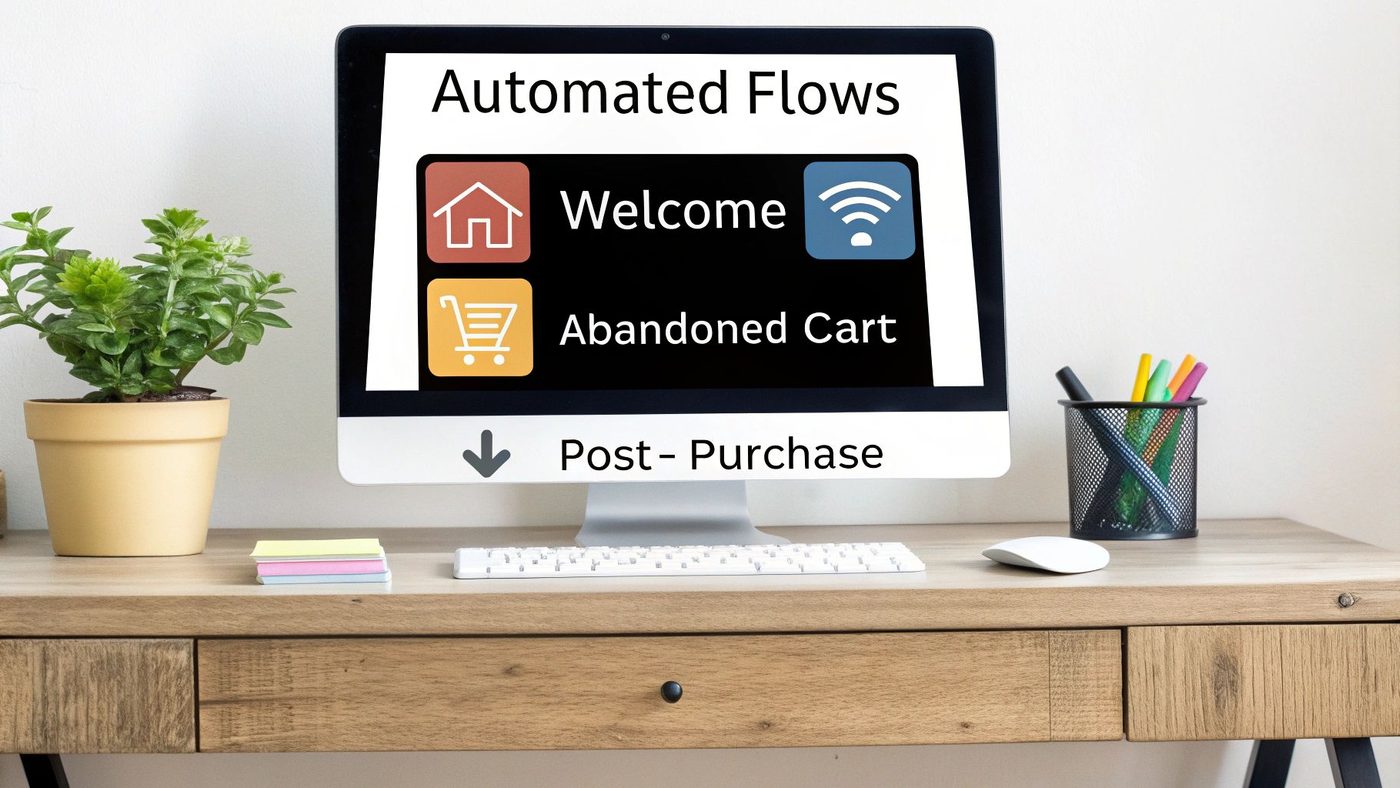
This is where your email strategy really starts to work for you. It’s the difference between manually pushing a boulder uphill and building a system that rolls it down for you, gathering momentum—and revenue—along the way.
While one-off campaigns for sales and product launches are crucial, your automated email sequences (often called "flows") are the true workhorses of a successful Shopify store. Think of them as your best salesperson, working 24/7. These pre-built messages get sent automatically based on what a customer does—or doesn't do—delivering the perfect message at just the right time.
The real magic here is its passive power. A customer signs up, and a welcome series kicks in. Someone leaves an item in their cart, and a gentle reminder brings them back. You invest the time to set them up once, and they keep engaging customers and driving sales around the clock, even while you sleep.
And it’s wildly effective. Automated messages consistently outperform standard promotional emails in both opens and clicks. For an ecommerce business, building an email list and nurturing it with smart automations is one of the highest-impact moves you can make, with some studies showing an ROI of $36 for every $1 spent.
Here’s a quick overview of the four essential flows that every Shopify store should have running from day one.
The Four Must-Have Automated Email Flows
This table breaks down the core purpose and impact of the four foundational automations you need to launch your email program successfully.
| Automation Type | Primary Goal | When to Send | Typical Impact |
|---|---|---|---|
| Welcome Series | Nurture new subscribers, build brand connection, and drive their first purchase. | Immediately after a new subscriber signs up. | High engagement, sets the tone for the customer relationship. |
| Abandoned Cart | Recover potentially lost sales from high-intent shoppers who left items behind. | 1-24 hours after a cart is abandoned. | The single highest revenue-generating automation for most stores. |
| Post-Purchase | Build loyalty, reduce buyer's remorse, and encourage repeat business. | A few days after a customer's order is fulfilled. | Increases customer lifetime value (LTV) and generates reviews. |
| Customer Winback | Re-engage inactive customers before they churn for good. | After a set period of inactivity (e.g., 90-180 days). | Retains customers at a lower cost than acquiring new ones. |
Getting these four flows live is your top priority. Let's dig into what makes each one tick.
The Welcome Series: Nailing Your First Impression
When someone gives you their email address, they are at their absolute peak interest. They've just raised their hand and said, "I like what you're doing, tell me more." Your welcome series is your chance to seize that momentum, make an unforgettable first impression, and smoothly guide them toward their first purchase.
A single welcome email is okay, but a series of two or three emails sent over a few days is exponentially better. This isn't just about dropping a discount code in their inbox—it's about telling a story and forging a genuine connection.
Your welcome flow should absolutely achieve these things:
- Deliver the Goods: Immediately send the discount or offer you promised on your signup form. No delays.
- Introduce Your Brand: Share your origin story. What makes you different? Why should they care?
- Showcase Your Winners: Don't make them guess. Point them directly to your best-selling products that everyone else loves.
- Build Trust with Social Proof: Sprinkle in some customer testimonials, five-star reviews, or user-generated photos to show them they're in good hands.
Pro Tip: Don't just sell. Use that first email to tell your founder's story or the mission behind your brand. People connect with people, and that initial bond can turn a one-time buyer into a lifelong fan.
The Abandoned Cart Flow: Your Sales Recovery Engine
Look, people abandon carts. It’s a fact of life in ecommerce. They get distracted by a phone call, second-guess the purchase, or get sticker shock from shipping costs. An abandoned cart flow is your safety net, automatically reaching out to these incredibly warm leads to coax them back over the finish line.
This is, without a doubt, the single most profitable automation you will ever set up. The data is clear: a huge chunk of those abandoned carts can be recovered with a timely, well-crafted email series.
A standard, high-performing abandoned cart flow usually has three parts:
- Email 1 (Sent ~1 hour after): A simple, friendly nudge. Think "Did you forget something?" or "Your cart is waiting for you."
- Email 2 (Sent ~24 hours later): Time to handle objections. Remind them of your awesome return policy, highlight a few product reviews, or reinforce what makes your product special.
- Email 3 (Sent ~48-72 hours later): If they still haven't bought, it's time for a small incentive. A modest discount like 10% off or free shipping is often the final push they need.
This is where a tool like Email Wiz shines. It pre-builds these proven sequences for you, automatically pulling in the exact products they left behind, complete with images and a direct link back to their checkout page. It couldn’t be easier for the customer.
The Post-Purchase Series: Building Loyalty and Second Sales
Your relationship with a customer doesn't end at the checkout. In many ways, it's just beginning. The post-purchase period is a golden opportunity to turn a one-time buyer into a loyal, repeat customer. A thoughtful follow-up shows you care about their experience, not just their money.
This flow is your chance to:
- Say Thank You: A simple, sincere thank-you note goes a long way in reinforcing their purchase decision and making them feel valued.
- Add Value: Help them get the most out of their purchase. If you sell skincare, send a "How to Use" guide. If you sell apparel, link to a post on three ways to style their new item.
- Ask for a Review: Once they've had a week or two to enjoy the product, ask them what they think. This feedback is invaluable social proof for future shoppers.
- Suggest What's Next: Recommend complementary products. Did they buy a coffee grinder? Suggest your best-selling espresso beans.
This is how you dramatically increase customer lifetime value. For a deeper look at this flow and others, check out our guide on 5 automated email flows that will skyrocket your Shopify sales.
The Customer Winback Flow: Re-engaging Lapsed Shoppers
It's natural for some customers to go quiet over time. A winback flow is your proactive plan to re-engage these "lapsed" customers before they're gone for good. This automation triggers when someone hasn't bought from you in a specific timeframe, like 90 or 180 days.
The goal is simple: remind them why they liked you in the first place. You can show them new products, highlight what's changed since their last visit, or offer an exclusive "we miss you" discount to entice them back. Remember, it costs far more to acquire a brand-new customer than to retain an existing one, making your winback flow a seriously high-ROI play.
Designing On-Brand Emails That Actually Convert
Think about your customer’s inbox. It’s a battlefield for attention. Your email’s design is your first—and maybe only—chance to stand out. It’s not just about looking pretty; every email you send is a digital handshake, a direct extension of your brand’s personality and promise.
A clunky, off-brand email feels like walking into a messy, untrustworthy shop. But a clean, professional, and on-brand design? That feels inviting and instantly reinforces the quality of your products. Nailing this is a cornerstone of effective email marketing.
Mastering the Core Elements of Email Design
Let’s be clear: great email design isn’t about cramming in flashy graphics. It's about clarity, consistency, and focusing obsessively on your customer's experience. The best emails are intuitive, guiding the reader’s eye right where you want it to go—straight to the call-to-action (CTA).
This all comes down to a strong visual hierarchy. Use headings, white space, and bold button colors to create a clear path for the reader. Your main message should grab them immediately, followed by the supporting details, and capped off with a CTA they simply can’t miss.
Here are a few design principles I’ve learned are absolutely non-negotiable:
- High-Quality Imagery: Your product photos are your silent salespeople. They need to be sharp, compelling, and professional. Make them count.
- Brand Consistency: Stick to the same logo, color palette, and fonts you use on your Shopify store. This consistency is what builds that instant, subconscious feeling of trust and recognition.
- Scannable Copy: Nobody reads an essay in their inbox. Break up your text with short paragraphs, bullet points, and bolded key phrases. People scan for what’s relevant to them.
The real goal of your design is to make it dead simple for a subscriber to understand your offer and click through to your store. Every single design choice should serve that one purpose.
Going through this manually and building templates from scratch can be a massive time-sink, especially when you're just starting out. It's a common hurdle that stops many Shopify owners in their tracks.
The Power of AI in On-Brand Template Creation
This is where technology can completely change the game. Instead of fiddling for hours in a drag-and-drop editor, trying to get your brand’s hex codes just right, generative AI can now do all that heavy lifting for you.
Tools like Email Wiz were built to solve this exact problem. With just one click, its AI scans your Shopify store, grabbing your logo, brand colors, and typography. It then instantly builds a whole suite of beautiful, on-brand email templates that are ready to go.
This means your welcome series, abandoned cart emails, and newsletters all look and feel perfectly aligned with your brand from day one—without you ever touching a design tool. You get professional, consistent branding across your entire email program, freeing you up to focus on what matters most: running your business.
Writing Copy That Connects and Converts
A stunning design gets the door open, but the words you use are what convince someone to step inside and make a purchase. Your email copy, from the subject line to the CTA button, has to be clear, persuasive, and all about the customer.
It all starts with the subject line. Its only job is to get the email opened. Keep it short, spark some curiosity, and hint at the value waiting inside. Ditch the generic stuff and focus on what makes your email uniquely valuable.
For the body copy, talk to your customer like a real person.
- Focus on benefits, not just features. Don't just sell a jacket; sell warmth, confidence, and style. How will your product make their life better?
- Use a conversational, human tone. Write like you speak.
- Keep your sentences and paragraphs short to keep the momentum going.
Finally, your call-to-action (CTA) needs to be obvious and urgent. Use action-packed phrases like "Shop Now," "Claim Your Discount," or "Explore the New Collection."
To see how powerful this combination of design and copy can be, check out these successful revenue-driving newsletter examples. By blending a sharp, on-brand design with copy that truly connects, you create an email experience that doesn't just look professional—it consistently drives sales.
Using Smart Segmentation to Boost Relevance and Sales
If you're sending the same generic email to every single person on your list, you're practically asking to be ignored or, worse, sent to the spam folder. The real magic of email marketing, especially for a Shopify store, isn't just about blasting out sales announcements—it’s about having a conversation. And that conversation only becomes meaningful when you use segmentation.
Segmentation is simply the practice of splitting your list into smaller, more focused groups. It lets you stop shouting at a crowd and start talking to individuals based on who they are, what they’ve bought, and what they’re interested in. It’s the difference between getting a random junk mail flyer and a personal recommendation from a friend who gets you.
Think about it: when you launch a new line of running shoes, wouldn't you rather that email went to people who've bought athletic gear before, instead of customers who only buy formal wear? That’s the simple, powerful logic behind segmentation.
Actionable Segmentation Strategies for Your Shopify Store
You don't need to get lost in the weeds with dozens of complex segments right away. In fact, you can see huge results just by focusing on a few high-impact groups. Your Shopify data is a goldmine for this, packed with real customer behaviors you can act on.
Here are a few essential segments every store owner should build from day one:
- First-Time Buyers: These folks just took a leap of faith and bought from you. Now's your chance to make a great second impression. A targeted follow-up that properly welcomes them, offers tips on their new product, and maybe nudges them toward a second purchase can dramatically increase their lifetime value.
- VIP Customers (Your biggest fans): Who are your ride-or-dies? You need to identify customers who have purchased multiple times or spent over a certain amount. Make them feel special. Reward their loyalty with early access to sales, exclusive discount codes, or a sneak peek at new collections.
- Inactive Subscribers (At risk of leaving): This is the group that hasn't bought or even opened an email in a while (think 90-120 days). Don’t just let them fade away. A targeted winback campaign with a compelling "we miss you" offer can reactivate a surprising number of these customers for way less than it costs to find a new one.
- Product or Category Viewers: Someone spent time browsing your "Handmade Leather Wallets" collection but didn't pull the trigger. That’s a massive signal of intent! Sending them a follow-up email that showcases those exact wallets, perhaps with a few glowing customer reviews, is incredibly relevant and often just the push they need.
The core idea is simple: relevance drives revenue. When you tailor your message to a customer's specific journey and interests, you make them feel seen and understood. That's how you build a brand people actually care about.
The Real-World Impact of Smart Targeting
Moving from generic blasts to targeted emails isn't just a "nice-to-have" anymore; it's essential for survival and growth. The data speaks for itself—segmentation and personalization are no longer optional.
Industry reports show that segmented emails can get 30% higher open rates and up to 50% higher click-through rates compared to one-size-fits-all campaigns. With 78% of marketers calling segmentation a top tactic for improving relevance, it’s clear where the smart money is. You can dig deeper into these numbers and discover insights on Hostinger.com.
This all just makes intuitive sense. A customer who gets an email referencing a product they literally just looked at is far more likely to click than someone who gets a random promotion for an item they couldn't care less about.
Let AI Do the Heavy Lifting on Segmentation
Now, the idea of manually sifting through customer data to build and maintain these segments probably sounds like a full-time job. And you'd be right. You have to constantly update your lists as customer behavior changes, which is precisely where most store owners get stuck and give up.
This is where AI-powered platforms like Email Wiz give you a massive, almost unfair, advantage.
Instead of you digging through spreadsheets, the AI does it for you—automatically and in real-time. It analyzes your Shopify customer data—purchase history, browsing behavior, order frequency, you name it—to create dynamic, intelligent segments without you lifting a finger.
For example, Email Wiz can instantly identify who your VIPs are and create a segment for them. It can spot customers who are showing signs of slipping away and group them for a winback campaign. This kind of automated intelligence ensures you’re always sending the most relevant message to the right person at the perfect time, maximizing your chances of making a sale. It turns a complex, time-consuming chore into a powerful background process that continuously works to make you more money.
Alright, let's get this done. Here’s how to go from zero to a fully functioning, money-making email program in just 30 days.
This isn't some theoretical exercise; it's a practical, week-by-week roadmap. We'll break it down into manageable chunks so you can build momentum and start seeing results quickly. Think of this as building a powerful new asset for your Shopify store, one that will pay dividends for years to come.
Week 1: Laying the Groundwork
Your first seven days are all about getting the plumbing connected. The goal is to get your email platform hooked up to Shopify, load your brand assets, and, most importantly, start capturing emails from your site visitors. Don't get bogged down in perfection here—the key is to get moving.
First, pick an email service provider that plays nicely with Shopify. A platform like Email Wiz is a no-brainer because it’s built specifically for this. You connect your store with a single click, and it automatically pulls in your logo, brand colors, fonts, and even your product catalog. This step alone will save you a ton of tedious design work.
Your checklist for this week is simple:
- Connect your email platform to your Shopify store.
- Activate a pop-up form with a juicy offer, like 15% off a first purchase.
- Add a sign-up form to your website’s footer.
- Turn on the checkout opt-in box to capture your most valuable contacts—your actual customers.
By the end of the week, you should have a live system for collecting new subscribers. You’re officially building your list.
Week 2: Activating Your Automated Engines
Now that emails are trickling in, it's time to put them to work automatically. Week two is all about launching the core automated flows that will run 24/7 in the background, engaging shoppers and recovering sales you’d otherwise miss.
Honestly, this is the highest-leverage thing you can do. These flows are your silent sales team, and getting them live early is how you maximize your return from day one.
My Two Cents: Don't waste time trying to write every single email from scratch. Modern tools like Email Wiz come with pre-built, proven templates for these exact flows. The copy is already persuasive, and the timing is optimized. Your job is to activate them, not reinvent the wheel.
Your main tasks are to launch:
- The Welcome Series: This is how you greet new subscribers and gently guide them toward their first purchase.
- The Abandoned Cart Flow: This is your sales recovery workhorse. For most stores, it will be the single most profitable automation you have.
Week 3: Sending Your First Real Campaign
With your automations humming along, it's time to send your first broadcast email. This is a one-off message sent to a segment of your list, maybe a simple newsletter, a new product drop, or a special promotion. The goal here is to start a real conversation and establish a rhythm with your audience.
Pick one clear objective for this email. Are you trying to drive traffic to a new blog post? Clear out old inventory? Announce a new collection? Focus on that one thing and build your email around it.
This is your first real test of what resonates with your subscribers. The data you gather here will be the foundation for your strategy for months to come.
Week 4: Analyzing and Optimizing
The last week of your first month is all about looking at the data. You now have some initial numbers from your automations and your first campaign. It’s time to see what worked, what didn't, and where you can make some quick improvements.
Don't get lost in a sea of metrics. For a Shopify store, you only need to focus on a handful of key performance indicators (KPIs) that actually matter.
The Only KPIs You Need to Track (For Now):
| Metric | What It Actually Tells You | A Good Starting Benchmark |
|---|---|---|
| Open Rate | Did your subject line grab their attention? | 20-25% |
| Click-Through Rate | Was your offer compelling enough to click? | 2-3% |
| Conversion Rate | Did people who clicked actually buy something? | 1-2% |
| Revenue Per Recipient | How much money did this email make per person? | Varies wildly, but track your own! |
Look at these numbers. If your open rate was low, your next subject line needs more punch. If clicks were high but conversions were low, maybe the landing page needs work. Use these early insights to make small tweaks for the month ahead. This is how you build a powerful, continuously improving email program.