Drip Campaign Definition A Guide to Automated Email Success
Explore our drip campaign definition guide. Learn how automated emails nurture leads and boost conversions with practical examples and expert strategies.

At its core, a drip campaign is a series of automated emails sent to people on your list over a set period. Think of it like a personal guide for your customers, working around the clock to send the right message at exactly the right time. It’s all about building a relationship and gently moving someone from just looking to making a purchase.
What Is a Drip Campaign Really?

Let's dig a little deeper than the basic definition. A drip campaign isn't just a bunch of pre-written emails. It's an intelligent, automated sequence that kicks off based on what a user does. It's less like a megaphone shouting the same thing to everyone (that’s a newsletter) and more like a series of one-on-one conversations.
These campaigns are triggered by specific actions. Maybe someone signs up for your newsletter, downloads a free guide, or even just browses a product category on your site. That action starts the clock, and the drip campaign begins delivering relevant information designed to keep them interested. This is what turns a casual browser into an engaged lead, making sure no one slips through the cracks. This kind of automated follow-up is a fundamental part of smart ecommerce marketing. If you want to dive deeper into this, check out our guide to ecommerce marketing automation.
Drip Campaigns vs. Newsletter Blasts
It’s easy to confuse the two, but the difference comes down to purpose and timing. Newsletters are generally one-off "blasts" you send manually to your entire list, like a weekly update or a holiday promotion. Drip campaigns, on the other hand, are automated, targeted, and triggered by what an individual does. That’s where the real magic of personalization happens.
A well-designed drip campaign does more than just send emails on autopilot. It builds relationships, nurtures leads, and guides people from initial curiosity all the way to checkout. It’s about being helpful and relevant, not just loud.
To really nail the distinction, let's break it down in a table.
Drip Campaigns vs Newsletter Blasts at a Glance
| Feature | Drip Campaign | Newsletter Blast |
|---|---|---|
| Trigger | Automated (user action or time-based) | Manual (sent on a specific date/time) |
| Audience | Segmented and individual-focused | Broad (often sent to the entire list) |
| Purpose | Nurturing, onboarding, conversion | Information, announcements, promotions |
| Timing | Based on the individual's journey | Same time for everyone |
| Content | Evergreen and sequential | Timely and topical |
As you can see, they serve very different functions in your marketing toolkit. Drip campaigns are all about the long game of relationship-building.
This strategic, automated approach allows you to achieve a few key things that are nearly impossible with manual sends:
- Personalization at Scale: Each email feels like it was written just for the recipient, based on their specific actions and interests, without you lifting a finger.
- Consistent Engagement: Your brand stays top-of-mind by delivering valuable content over time, keeping your audience warm without spamming them.
- Strategic Timing: Messages arrive exactly when they’ll have the most impact—right after someone shows interest or when they need a little nudge to take the next step.
This is what makes drip marketing so effective. To see how different platforms handle this, it's worth checking out some of the best drip campaign software options available.
How Automated Drip Campaigns Actually Work
At their core, every drip campaign operates on a simple but incredibly powerful concept: "if this happens, then do that." It's a chain reaction you set up in advance, creating a perfectly timed, hands-off experience for your customers. No more manually sending follow-ups; the system does it all for you.
This whole process relies on three key building blocks that work together to bring your campaign to life. Once you understand how they fit together, you’ll see just how much you can accomplish with automation.
Let’s pull back the curtain and look at how it's done.
The Core Components of a Drip Campaign
Think of a drip campaign as having three essential parts. Each one plays a specific role in guiding a subscriber through their journey with your brand.
- Triggers (The "If This"): This is the starting gun. A trigger is the specific action a person takes that officially enters them into your automated sequence. Common triggers include signing up for your newsletter, adding an item to their cart, or making their first purchase.
- Conditions (The "Wait and See"): These are the rules of the road. Conditions dictate the timing and flow of your campaign. They can be simple time delays (like "wait 24 hours") or more complex logical splits (like "if the person opened the last email, do this; if not, do that"). They control the pace and the path.
- Actions (The "Then That"): This is what actually happens next. The most common action is sending an email, but it doesn't stop there. An action could also be adding a specific tag to a contact's profile, moving them to a new email list, or even sending a notification to your sales team.
For example, when someone subscribes, they trigger your welcome series. The first condition is to wait 1 hour. Then, the system performs the action of sending your first welcome email. Another condition might be to wait three days before sending the next one.
This basic structure is the foundation of any automation you build. If you're just getting started, learning how to build your first marketing automation workflow is a great way to get hands-on with these concepts.
Elevating Automation with Segmentation
Here's where things get really interesting. The basic trigger-condition-action model is great, but adding segmentation is what makes it smart. Segmentation lets you create different paths within the same workflow based on who your subscribers are and how they behave.
Instead of sending every single person the exact same sequence of emails, you can start personalizing the journey.
For instance, you could add a condition that checks a subscriber's purchase history. If they've bought from your "men's apparel" category before, you can send them emails showcasing new arrivals in that section. If they've never bought anything, you can send them a first-time-buyer discount. This is how automated messages start to feel personal, relevant, and much more likely to drive a sale.
Essential Drip Campaigns for Business Growth
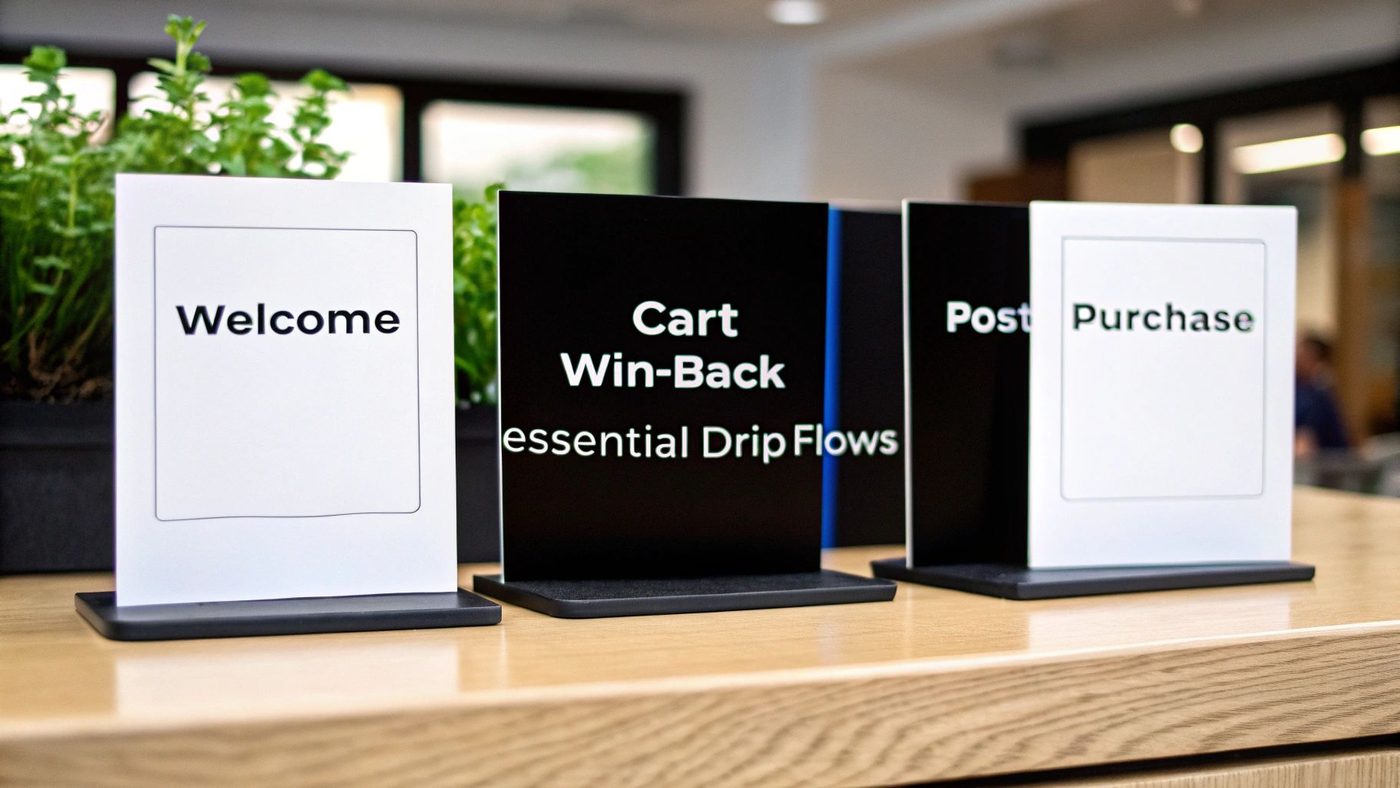
It’s one thing to understand the theory behind drip marketing, but seeing it work in the real world is where the magic really happens. A few automated email sequences are so powerful and reliable that they've become non-negotiable for any growing business. Think of them as your best employees, working 24/7 to turn new leads into customers and one-time buyers into lifelong fans.
Let’s walk through four of the most critical drip campaigns every business should have running. Each one is designed to meet customers at a pivotal moment in their journey, delivering just the right message at exactly the right time.
The Welcome Series
Your welcome series is your first impression—your digital handshake. It kicks off the very second someone joins your email list, and its mission is simple: make an immediate, positive connection. This is your chance to show off your brand’s personality, set the stage for what’s to come, and deliver on whatever you promised them for signing up (like that sweet 10% off coupon).
A solid welcome series often follows this kind of rhythm:
- Email 1 (Sent Immediately): Delivers the goods (the discount code or freebie), says a genuine "thank you," and briefly shares what your brand is all about.
- Email 2 (Wait 2 Days): Puts your best foot forward by highlighting best-selling products or your most popular content. It’s a gentle nudge toward the good stuff.
- Email 3 (Wait 3 Days): Builds trust by sharing social proof. Think glowing customer reviews, five-star testimonials, or photos from happy customers.
The Cart Abandonment Flow
For any ecommerce store, this is the MVP of automated emails. It’s your secret weapon for recovering lost sales. When a shopper adds an item to their cart but gets distracted and leaves, this sequence jumps into action. Its only job is to gently remind them about the great things they left behind and make it easy to come back and finish the purchase.
The numbers don't lie. For every 100 abandoned cart emails sent, about 45 get opened. Of those, 21 people will click back to their cart, and a staggering 11 will complete their purchase. That’s found money, recovered automatically. Research from MailMunch on drip campaign effectiveness dives deeper into these impressive stats.
Core Message: "Still thinking it over? Your items are saved and waiting for you." This simple reminder, often paired with a little urgency or a small bonus, works wonders.
The Post-Purchase Follow-up
The sale isn't the end of the conversation; it’s the beginning of a real relationship. A post-purchase drip campaign is all about reassuring customers they made a great choice, getting them excited for their order, and paving the way for them to come back again. This is how you create loyal, repeat buyers.
Here’s what this flow usually includes:
- Order Confirmation (Immediate): A clean, reassuring email that lays out all the purchase details. Peace of mind in an inbox.
- Shipping Notification (When Shipped): Builds anticipation and gives the customer the tracking info they're looking for.
- Product Review Request (7-14 Days Post-Delivery): Asks for honest feedback while the product experience is still fresh in their mind.
The Win-Back Campaign
It's natural for some customers to drift away over time. A win-back campaign is your proactive strategy to re-engage these quiet subscribers before they're gone for good. It’s typically triggered after a set period of inactivity—say, 90 days without opening an email or making a purchase—and aims to remind them why they liked you in the first place.
The message is usually a friendly "we miss you," often paired with a special offer to entice them back or a quick survey to understand why they've been distant.
Of course, these four flows are just the start. You can find even more powerful automation ideas in our guide on the 5 automated email flows to skyrocket Shopify sales.
You’ll often hear people use the terms “drip campaign” and “nurture campaign” interchangeably, but they’re not quite the same thing. Think of them as two different levels of a similar strategy. They both use a series of automated emails to talk to your audience, but how they think and what they aim to do are fundamentally different.
Nailing down this distinction is crucial because it helps you pick the right tool for the job.
A classic drip campaign is like a pre-set tour. Everyone who signs up gets on the same bus, sees the same sights in the same order, and gets off at the same final stop. The path is fixed. This linear, time-based approach is perfect for straightforward goals where everyone benefits from the same information, like a welcome series or a cart abandonment reminder.
Dynamic Paths vs Fixed Schedules
Now, a nurture campaign is more like having a personal guide. It knows the final destination—turning a curious browser into a loyal customer—but it adjusts the route based on what you’re interested in along the way. It’s dynamic and responsive.
A nurture campaign doesn't just blindly send the next email on the list. It pays attention. Did someone click a link about your new running shoes? The campaign pivots, sending them a guide on picking the right shoe for their gait instead of the generic company newsletter it had planned.
This ability to react is what truly defines nurturing. While drip campaigns are typically triggered by time ("send email #2 three days after email #1"), nurture campaigns are driven by behavior. They use "if/then" logic to create personalized journeys that adapt to how each person interacts with your brand.
It's a much more tailored conversation. Here’s a simple way to look at the key differences:
- Drip Campaigns: * Logic: Follows a fixed, time-based schedule. It’s linear. * Goal: Best for general actions like onboarding new subscribers or re-engaging old ones. * Complexity: Simple and straightforward to set up.
- Nurture Campaigns: * Logic: Changes based on user behavior. It’s dynamic, with branching paths. * Goal: Ideal for guiding prospects through a sales funnel based on their unique actions and interests. * Complexity: More advanced, requiring conditional logic to create multiple potential journeys.
At the end of the day, all nurture campaigns are a form of drip automation, but not all drip campaigns are smart enough to be considered true nurturing.
Getting the Most Out of Your Drip Campaigns
It’s one thing to launch a drip campaign; it’s another to build one that actually gets results. Without a clear plan and a good sense of who you're talking to, even the best-written emails will likely miss the mark. A killer drip campaign is more than just automation—it's about creating a journey for your subscribers that feels personal and genuinely helpful.
Think of it like having a good conversation. You’re anticipating what someone needs, offering something of value, and gently guiding them toward what comes next. To get there, you need a solid framework that’s all about being clear, relevant, and always looking for ways to improve. For a deeper dive, you can also check out some essential drip campaign best practices.
Nail Down One Clear Goal
Before you even think about writing, you have to ask: what is the one thing I want this campaign to achieve? Are you trying to make new subscribers feel welcome? Nudge people to complete their checkout? Or maybe win back customers who haven’t shopped in a while?
Every single email in your sequence needs to point back to that one core objective. If your goal is fuzzy, your emails will feel random and confusing. Focus on a specific, measurable outcome.
Key Takeaway: Don’t try to do everything at once. A welcome series should be about introducing your brand and building trust, not pushing your most expensive product on day one. A laser-focused goal is your north star for every decision you make.
Segment Your Audience for a Personal Touch
Blasting the same generic message to your entire list is a surefire way to get ignored. This is where segmentation comes in. It’s simply the process of grouping your audience based on things like their behavior, demographics, or what they’ve bought before. The payoff is huge—marketers who use segmented campaigns report a staggering 760% increase in revenue.
It lets you create different paths for different people. For example:
- New Visitors: They get a welcome series that tells your brand story and shows off some social proof.
- Loyal Customers: You can send them info about your loyalty program or new arrivals that match their past purchases.
- Quiet Subscribers: They can be nudged with a win-back campaign that includes a special offer to bring them back.
This kind of personalization makes your emails feel like they were written just for them, which is the exact opposite of spam.
Write Subject Lines and Copy That People Actually Read
Your subject line is your email's first impression. Get it wrong, and you’re headed straight to the trash folder. A great subject line sparks curiosity, creates a little urgency, or just tells people exactly what value is waiting for them inside. Keep it brief—under 50 characters is the sweet spot for mobile.
Once they open the email, make the content easy to scan. Think short paragraphs, bolded text for key points, and a crystal-clear call to action (CTA). Write like a real person, not a faceless company. It’s how you build a real connection.
And finally, A/B test everything. Seriously. Test your subject lines, your CTA buttons, even the time of day you send the email. This is how you stop guessing and start making data-driven decisions that turn a good campaign into a great one.
Measuring Your Drip Campaign Success
Launching a drip campaign without a way to measure it is like flying a plane with no instruments. You might be moving, but you have no idea if you're headed in the right direction. To figure out what's working—and, just as importantly, what isn't—you have to get comfortable with the data.
This is what separates a decent strategy from a great one. The data tells you the real story, not just how many people saw your email, but how their actions actually impacted your sales. By keeping a close eye on a handful of key metrics, you can turn your automated emails into a reliable engine for growth.
Key Metrics You Must Track
To get a clear picture of your campaign's performance, you need to look at more than just one number. Think of each metric as a different clue; together, they help you solve the puzzle of what your customers want and how to give it to them.
Here are the essential KPIs you should have on your dashboard:
- Open Rate: This is your first impression. It’s the percentage of people who actually opened your email. If this number is low, your subject line probably isn't grabbing enough attention in a busy inbox.
- Click-Through Rate (CTR): This metric tells you how many of those openers were interested enough to click a link. A solid open rate but a weak CTR often means your email's content or call-to-action missed the mark.
- Conversion Rate: This is the big one—the whole reason you're sending emails in the first place. It tracks the percentage of people who took the action you wanted, like making a purchase or signing up.
- Unsubscribe Rate: Pay close attention to this. It shows how many people are opting out. If this number starts to climb, it’s a strong signal that your content is irrelevant or you're sending emails too often.
When you look at these metrics together, you can diagnose problems with incredible precision. For instance, a high open rate paired with a low click-through rate tells you the subject line made a promise that the email body didn't deliver on.
One of the best things about automated flows is how well they perform. Welcome series, for instance, boast an average open rate of 48.57%, and the best ones hit an amazing 65.74%. These stats prove why a solid drip campaign strategy must be built on measurable results. You can discover more insights about drip campaign benchmarks on Klaviyo.com.
Drip Campaign Strategy: Conclusion
Ready to get powerful drip campaigns running for your Shopify store, but without all the usual hassle? Email Wiz uses AI to build and run your entire email marketing channel in a single click. From welcome series to abandoned cart flows, you get proven results automatically. Start growing with Email Wiz today.
Frequently asked questions
- How Many Emails Should I Send in a Drip Campaign?
- There’s no magic number here, and honestly, it’s a trap to even look for one. Quality always, always beats quantity. A welcome series might feel natural with three to five emails spread out over a week or two. On the other hand, a cart abandonment flow is often most effective with just one or two quick reminders. The real key is to make sure every single email has a clear purpose. When the journey feels complete, it's time to stop. Jamming inboxes with extra messages is just a fast track to getting people to unsubscribe. Think of it this way: a good drip campaign should be as long as it needs to be to hit its goal, and not a single email longer. The best drip campaigns feel like a helpful, well-timed conversation. They have a natural ending once the goal is met, whether that's welcoming a new customer or recovering a lost sale. Don't stretch out a sequence just for the sake of sending more emails.
- What’s the Secret to a Successful Drip Campaign?
- Success really comes down to a simple, three-part formula: relevance, timing, and a clear goal. You need to send the right message (relevance) at the exact moment a subscriber is most likely to open it and take action (timing), all while working toward a specific outcome (goal). If any one of those pieces is missing, even the most beautifully written emails will fail to connect. And what powers that all-important relevance? Smart, thoughtful segmentation. It's the engine that makes sure your messages actually resonate with the people receiving them.
- Are Drip Campaigns Still Effective?
- Absolutely. In fact, you could argue they’re more important now than ever for building genuine customer relationships and driving sales on autopilot. The data backs this up, too. B2B companies that use drip campaigns generate 50% more sales-ready leads at a 33% lower cost. Numbers like that show precisely why automated, timely communication is still a core pillar of any smart marketing strategy. You can dig into more stats about the impact of drip marketing over on Cognism.com.