Marketing Automation Ecommerce: Boost Sales with Automated Workflows
- Guy Williams

- Jan 19
- 16 min read
Updated: May 6
Think of ecommerce marketing automation as your store's secret weapon. It’s the smart use of software to handle all those repetitive marketing jobs, freeing you up to focus on the bigger picture. This tech is like having an extra team member who works 24/7, sending the right message to the right person at the perfect time—all without you lifting a finger.
Putting Your Shopify Marketing on Autopilot
Imagine a version of your store that personally welcomes every new subscriber, gently nudges shoppers who left items in their cart, and sends a thoughtful thank-you note after every single purchase. That’s the real magic of marketing automation for ecommerce. It flips the script, turning your marketing from a daily grind into a powerful, self-running engine that generates sales.
Moving Beyond Manual Marketing
When you're just starting out, managing marketing by hand feels doable. A few customer emails here, a social media post there—it's like juggling a couple of balls. But as your Shopify store grows, more and more balls get added to the mix. Before you know it, you're dropping them, missing crucial chances to connect with customers when it matters most.
Marketing automation is your safety net. It’s a system that never gets tired and never misses a beat. Instead of you having to remember to send every single message, the software takes care of it based on what your customers do.
Think of it as your best salesperson, one that nurtures relationships and drives sales even while you sleep. By setting up a few simple, automated workflows, you create a system that works for you, not the other way around.
How Automation Creates a Self-Sustaining Engine
The real genius of marketing automation for ecommerce is its ability to deliver personal-feeling interactions on a massive scale. It all comes down to triggers and actions. A "trigger" is just a specific behavior a customer takes, which then sets off a pre-planned "action."
It’s simpler than it sounds. For example:
Trigger: A visitor signs up for your newsletter.
Action: The system immediately sends them a friendly welcome email, maybe with a first-time-buyer discount.
Trigger: A shopper adds a product to their cart but doesn't check out.
Action: A few hours later, an automated email pops into their inbox reminding them of what they left behind.
These straightforward sequences are the building blocks of a killer automation strategy. They make sure no opportunity slips through the cracks, turning would-be lost sales into revenue and new customers into repeat buyers. In this guide, we'll break down exactly how to build these essential workflows to turn your store into an efficient machine that grows sales and strengthens customer loyalty.
What Is Marketing Automation in Ecommerce?
Let's cut through the noise. When we talk about marketing automation in ecommerce, we're not talking about complex code or robotic, impersonal messages. At its core, it's about setting up a system to send the right message to the right person at the perfect time—all without you lifting a finger for each one.
Think of it as your store's best employee. This employee works 24/7, notices every little thing a customer does, and instantly knows how to respond in a helpful, relevant way. It's how you make thousands of customers feel individually valued, scaling personal connection in a way that’s simply impossible to do by hand.
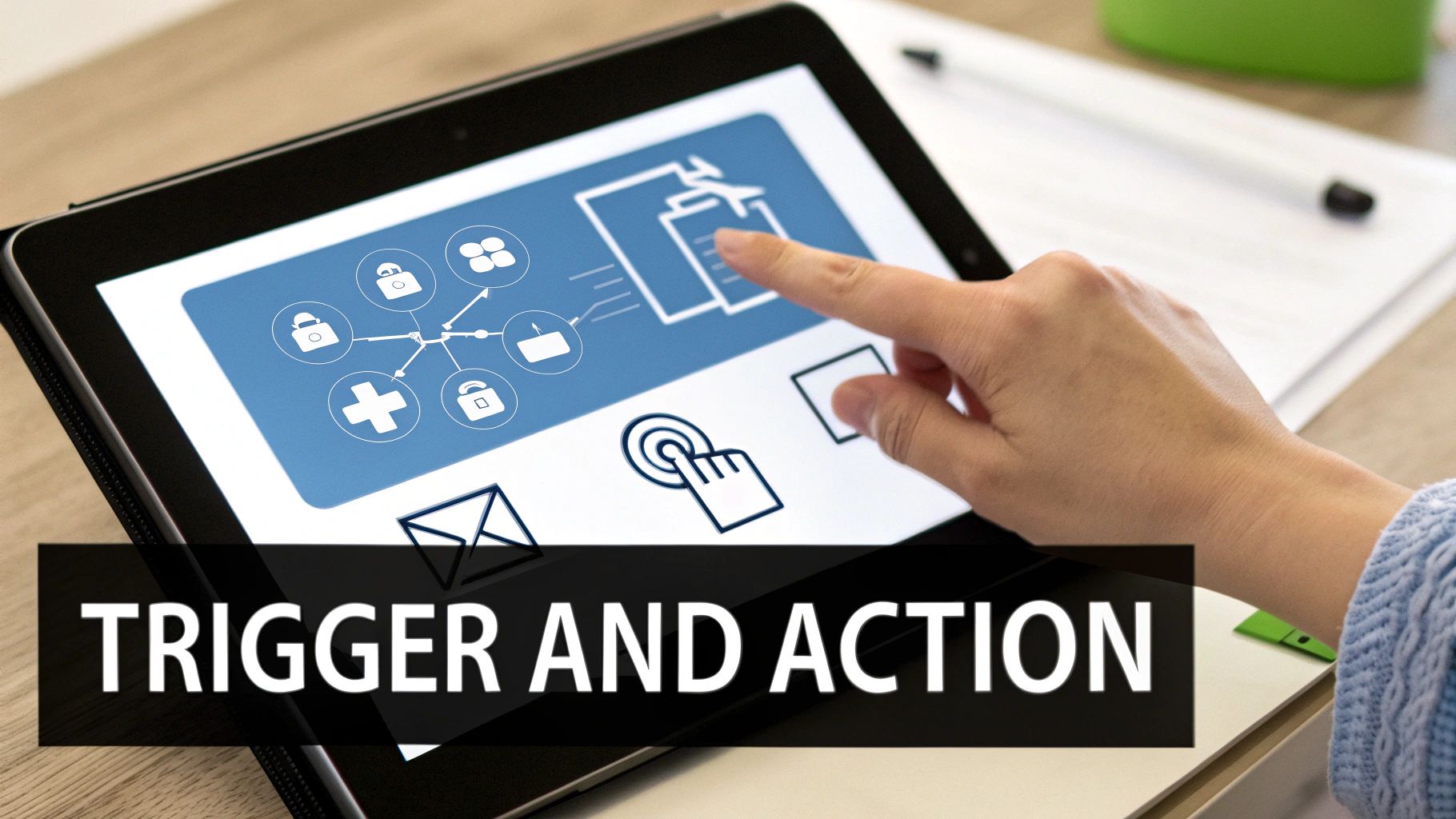
The whole thing runs on a beautifully simple principle: triggers and actions.
Understanding the Trigger and Action Framework
A trigger is just a fancy word for something a customer does on your Shopify store. It could be anything from signing up for your newsletter to adding an item to their cart or making a purchase. It’s the signal that kicks your system into gear.
An action is the automatic response that happens right after a trigger. Most of the time, this means sending a specific email or SMS, but it could also be something like adding a tag to a customer's profile for later.
Here’s a classic example of how this plays out:
Trigger: A new visitor subscribes to your email list.
Action: The system immediately sends them your pre-written welcome email.
That single, instant interaction confirms their sign-up, delivers on its promise (maybe a discount code?), and starts the customer relationship off on the right foot. It's this immediate, responsive communication that makes marketing automation in ecommerce so incredibly powerful.
How Automation Turns Behavior into Revenue
Every click, every product view, and every purchase is a piece of a story. Automation tools are designed to read that story and respond with timely, relevant marketing that feels like a conversation, not a broadcast.
And the results speak for themselves. Recent studies show that a staggering 31% of all email orders come from automated messages, even though they represent just 1.8% of all emails sent. This incredible efficiency shows just how well targeted messages perform, with some automated workflows bringing in up to 30x more revenue per recipient than a standard, one-off campaign. You can discover more insights on email marketing automation statistics to see the full picture.
Automation doesn't just send emails; it creates conversations. By responding to what customers actually do, you build a foundation for lasting relationships and turn one-time buyers into loyal fans.
This intelligent system is what allows you to create highly personalized customer journeys at scale, ensuring every single person receives communication that’s directly tied to their unique experience with your brand.
Comparing Manual vs. Automated Marketing
For a busy Shopify merchant, the difference between doing marketing tasks by hand and letting a system handle them is night and day. Automation isn't just a nice-to-have; it's a complete shift in how you operate, giving you back time while improving your results.
Let’s look at a side-by-side comparison. It really highlights how one approach requires constant oversight while the other works behind the scenes to capture every opportunity.
Manual vs Automated Marketing: A Comparison for Shopify Stores
Marketing Task | The Manual Way (High Effort, Slow) | The Automated Way (Low Effort, Instant) |
|---|---|---|
Welcoming New Subscribers | You export a list of new subscribers every day or so and manually send out a generic welcome email. It's slow, often delayed, and feels impersonal. | A personalized welcome email is sent the instant a user subscribes. It can include their name and a unique discount to encourage a first purchase. |
Recovering Abandoned Carts | You might notice a few abandoned carts and send a one-off reminder if you have time, but most of these high-intent shoppers are lost for good. | A timed series of emails automatically goes out to every shopper who leaves items behind, recovering an average of 10-15% of lost sales. |
Following Up Post-Purchase | Sending thank-you notes or asking for reviews is hit-or-miss. It’s a great idea in theory, but impossible to do consistently for every order. | Every single customer automatically gets a thank-you note, shipping updates, and, after a set time, a request for a product review. |
Re-engaging Old Customers | Figuring out who hasn't bought in a while and reaching out to them is a huge, time-consuming project that usually gets pushed to the back burner. | The system automatically spots customers who haven't purchased in 90 days (or any period you set) and sends a targeted win-back offer to them. |
As you can see, automation takes repetitive, time-sensitive tasks off your plate and executes them perfectly every time. This frees you up to focus on the bigger picture—growing your brand.
The Five Must-Have Automated Email Flows
If marketing automation is the engine running your Shopify store, think of these automated email flows as the pistons firing in perfect sequence to drive it forward. These aren't just one-off messages. They're carefully timed, psychologically-driven conversations that kick in at the most critical moments of the customer journey.
Setting up these core flows is the fastest way to see a real financial return from your automation efforts. They work 24/7 to build relationships, recover lost sales, and foster loyalty, forming the very foundation of a solid marketing automation ecommerce strategy.
Let’s break down the five essential flows every single merchant needs to have running.
1. The Welcome Series
Your welcome series is your store's digital handshake. It's your single best opportunity to turn a curious new subscriber into a paying customer. This isn't just one email; it’s a short sequence designed to introduce your brand, build immediate trust, and push for that all-important first purchase.
Think of it like being a great host at a party. When a new guest arrives, you don't just ignore them. You welcome them in, show them around, and make them feel comfortable. This flow does exactly that, making new subscribers feel seen and valued from the moment they join.
A great welcome series does more than just say "hello." It sets the tone for your brand, highlights what makes you special, and uses a compelling offer to convert subscribers while their interest is at its absolute peak.
This series is so powerful because it strikes while the iron is hot. The subscriber just took an action to sign up—they're actively leaning in, waiting to hear what you have to say.
2. The Cart Abandonment Flow
This is, without a doubt, the most valuable piece of the marketing automation ecommerce puzzle. Industry-wide, nearly 70% of online shopping carts are abandoned before a purchase is made. That's a staggering amount of potential revenue just sitting there.
A cart abandonment flow is your automatic safety net, built to bring these high-intent shoppers back to your store. They've already done the hard part: they browsed your products, found something they liked, and added it to their cart. This sequence just gives them a gentle, timely nudge to cross the finish line.
The psychology is simple. Life happens. Shoppers get distracted, they balk at shipping costs, or they just decide to "sleep on it." A well-timed email with a picture of the items they left behind can be incredibly effective at rekindling that initial desire to buy.
A typical sequence looks something like this:
Email 1 (1-4 hours after abandonment): A simple, helpful reminder. "Did you forget something?"
Email 2 (24 hours later): A follow-up that might build urgency or highlight product benefits.
Email 3 (48-72 hours later): The final nudge, often with a small incentive like free shipping or a 10% discount to close the deal.
For a deeper look at what makes these emails work, check out our guide on how to recover lost Shopify sales with abandoned cart emails. This one flow alone can dramatically increase your store’s revenue without any extra day-to-day work.
3. The Post-Purchase Series
The moment a customer clicks "buy" isn't the end of their journey—it's the beginning of a long-term relationship. A post-purchase flow is all about building on that initial excitement to turn a one-time buyer into a loyal, repeat customer.
This series goes way beyond a generic order confirmation. It’s your chance to thank the customer, provide real value, and set the stage for their next purchase. Your goal is to make them feel fantastic about their decision to choose you.
This sequence can include several key touchpoints:
The "Thank You" Email: A genuine message of appreciation that confirms their order details.
Shipping Updates: Automated notifications that keep them in the loop and cut down on "Where's my order?" support tickets.
Product Education: Tips, tutorials, or guides on how to get the most out of their new purchase.
The Review Request: An email sent after they've had a chance to use the product, asking for that powerful social proof.
By staying in touch during this crucial honeymoon phase, you reinforce their trust and keep your brand top-of-mind for the future.
4. The Browse Abandonment Flow
This one is a bit more advanced but incredibly effective. A browse abandonment flow targets shoppers who viewed a specific product but left your site without ever adding it to their cart. Think of it as a way to re-engage the "window shoppers."
While they aren't as far down the funnel as a cart abandoner, these visitors showed clear interest in a particular item. This flow works by simply reminding them of that product, usually with a great image and a direct link back to the page.
This level of personalization shows you're paying attention, which makes the email feel relevant and helpful, not creepy or random. It's a proactive tactic to pull interested visitors back into your orbit before they forget about you and move on.
5. The Customer Winback Campaign
It costs way more to acquire a new customer than it does to bring a past one back. That’s why a customer winback campaign is so important. This automated flow targets previous customers who haven't bought anything from you in a set amount of time, like 90 or 180 days.
The goal is simple: remind them you exist and give them a compelling reason to return. Often, these emails include an exclusive offer they can't ignore, like "We Miss You! Here’s 15% Off Your Next Order."
These flows are essential for maximizing the lifetime value of every customer. They automatically find and re-engage at-risk shoppers, preventing churn and turning dormant accounts into active, profitable ones. The data doesn't lie—54.2% of ecommerce automation workflows focus on cart abandonment, followed by welcome emails at 30.8%. And stores that get this right see an average revenue bump of 34% just by capturing these opportunities.
Measuring Your Automation Success and ROI
So you've set up your automated flows. That's a huge step. But how do you actually prove they're making you money? The real trick is to look past the shiny, surface-level numbers—what we call "vanity metrics"—and dig into the data that directly impacts your bank account.
Effective marketing automation for ecommerce isn't just another monthly expense. It’s a powerful engine for growth, and you need to be able to measure its return on investment (ROI).
Think of it this way: your email open rate is like knowing how many people walked into your physical store. It's nice to know, but it doesn't pay the bills. The real story is in the revenue per recipient, which tells you how much money those people actually spent. That's where you find true success—in recovered sales, happier customers who spend more, and a clear financial return.
When you shift your focus, your automation platform stops looking like a cost and starts looking like your hardest-working salesperson. It’s a salesperson who works 24/7, by the way. This also gives you the hard data you need to do more of what's working and fix what isn't.
Key Metrics That Truly Matter
To get a real sense of your automation's financial impact, you have to track the right key performance indicators (KPIs). These are the numbers that connect the dots between your email campaigns and your store’s revenue.
Here are the three big ones you should be watching like a hawk:
Recovered Revenue: This is the clearest measure of success for your cart and browse abandonment flows. It's the total dollar amount you've clawed back from shoppers who clicked a link in a recovery email and finished their purchase. Pure and simple.
Revenue Per Recipient (RPR): A killer metric for any email you send. RPR shows you the average revenue generated by each person who received that email. You just divide the total revenue from a campaign by the number of people you sent it to.
Customer Lifetime Value (CLV) Uplift: This one is more of a long-term play. It shows how your automation, especially post-purchase and winback flows, is increasing the total amount a customer spends with you over their entire relationship. By nudging them toward that second or third purchase, you're directly boosting their CLV.
While other metrics like Click-to-Open Rate are definitely important for gauging how engaging your emails are, these revenue-focused KPIs are what will prove your automation strategy's worth to you and your team. If you want to dive deeper, you can learn more about why Click-to-Open Rate is your most important metric right here: https://www.emailwiz.ai/post/what-is-click-to-open-rate-and-why-it-s-your-most-important-metric
Calculating the ROI of Your Cart Recovery Flow
Let's walk through a quick, real-world example to see just how quickly this stuff pays for itself. Imagine your Shopify store has a basic cart recovery flow running. You want to figure out its ROI for last month.
Here's the data you'll need:
Total Carts Abandoned: 500
Emails Sent by the Flow: 500
Carts Recovered via Email: 50 (that's a 10% recovery rate)
Average Order Value (AOV): $80
Monthly Cost of Your Automation Software: $49
First, let's figure out your Recovered Revenue:
50 Recovered Carts x $80 AOV = $4,000 Recovered Revenue
Not bad. Now, let's calculate the ROI:
(($4,000 Recovered Revenue - $49 Software Cost) / $49 Software Cost) x 100 = 8,063% ROI
The numbers don't lie. A single, well-crafted automated flow can generate a staggering return. To better quantify the impact of your campaigns and forecast what's possible, you can utilize a conversion rate calculator to project potential gains.
This kind of tangible data is what allows you to make smarter, more confident decisions for your business. The financial upside is undeniable: studies show that every $1 invested in marketing automation brings back an average of $5.44. For any Shopify store, that's a high-impact investment. Most merchants see a positive ROI within the first year, with many seeing serious revenue growth in as little as six months. By tracking the right numbers, you'll know exactly where to put your time and money to keep growing.
Choosing the Right Automation Tool for Shopify
Picking the right marketing automation platform for your Shopify store can feel like a monumental task, but it doesn't have to be. The secret isn't getting lost in a spreadsheet comparing hundreds of features. It's about focusing on what will get you the fastest, most reliable results.
Think of it this way: your automation tool should be a partner that makes your life easier, not another complicated system you have to manage. For a busy store owner, it all boils down to three simple things: how well it plays with Shopify, how fast you can get up and running, and how simple it is to use every day.
Core Features to Prioritize
When you're looking at different options, you need to cut through the marketing fluff. Zero in on the non-negotiable features that will actually save you time and make you money. These are the building blocks of a solid automation strategy.
Make sure any tool you consider checks these boxes:
Seamless Shopify Integration: This is everything. The platform absolutely must connect deeply with your Shopify data—customers, orders, products, the works. Without this, your segmentation and personalization efforts will fall flat.
Pre-Built Workflow Templates: A great tool doesn't force you to reinvent the wheel. It should come loaded with proven, ready-to-go templates for the essential flows: welcome series, abandoned carts, and post-purchase follow-ups.
An Intuitive User Interface: You shouldn't need a Ph.D. in software to send an email. The best platforms are built for merchants, with clean dashboards and drag-and-drop editors that just make sense.
Transparent and Scalable Pricing: Stay away from platforms with confusing pricing models or surprise fees. Find a plan that fits your current business but gives you room to grow without breaking the bank.
Ultimately, it comes down to a simple choice. Do you want an all-in-one behemoth with features you’ll never touch, or a focused tool designed to drive Shopify sales right out of the box? For most merchants, the second option is the smarter move. You can dive deeper into this topic by reading our buyer's guide to Shopify email marketing apps.
Key Questions to Ask Vendors
Before you sign on the dotted line, come prepared with a few sharp questions. This checklist will help you quickly tell which vendors truly understand what an e-commerce business needs.
How long does it really take to get the essential email flows live?
Does your platform automatically pull in my Shopify branding—logo, colors, and fonts?
Are your pre-built templates actually tested and proven to convert for stores in my niche?
How does your pricing change as my list and my revenue grow?
The goal is to find a solution that helps you launch a professional-grade email program in minutes, not weeks. The best tools do the heavy lifting for you, freeing you up to think about the big picture.
The good news is that the market for these tools is exploding. The global marketing automation industry is expected to reach $15.58 billion by 2030, which means more competition, better features, and more affordable options for merchants. This growth makes powerful automation accessible to everyone, not just the big-box retailers. By choosing wisely, you can set up a system that doesn't just pay for itself but becomes one of the biggest drivers of your store's growth. You can explore more about this market growth and what it means for your business.
Getting Your First Automation Campaigns Off the Ground
Alright, you’ve got the tools and the basic strategy down. It's time to get your hands dirty and launch. The secret to winning with marketing automation isn't about building some crazy, complex system right out of the gate. It’s about starting with a few simple, powerful campaigns and building from there.
Think of it like building a house. You don't start with the fancy crown molding. You pour a solid concrete foundation first. For your store, that foundation is a handful of essential workflows that bring in revenue and start building real customer relationships from the moment someone finds you.
Start with the Heavy Hitters
Don't boil the ocean. Seriously, trying to do everything at once is a surefire way to get nothing done. Instead, focus on the campaigns that will give you the biggest bang for your buck, right now. This approach gets you some quick wins, proves the value of your work, and generates revenue you can see.
For just about any Shopify store, that means starting with these two flows:
The Welcome Series: This is your best shot at turning a curious new subscriber into a first-time buyer. Their interest is sky-high at this moment—don't waste it.
The Cart Abandonment Flow: This is pure profit recovery. It's a simple, automated way to chase down sales that were this close to happening but slipped away.
By nailing these two, you’re covering the most critical moments in the customer journey: the first hello and the final decision to buy.
Tips for a Smooth Launch
Once you know where you’re starting, a few simple rules of thumb will keep you on track. The goal here is clarity and consistency, not creating a marketing masterpiece on day one. Keep your email designs clean and make your call-to-action impossible to miss. Tell people exactly what you want them to do.
Make sure your automated emails sound like you. They are a direct extension of your brand. If your site is fun and casual, your emails should be too. Consistency builds trust.
After you hit "go," fight the urge to tinker. Let your automations run for a bit. You need to collect enough real-world data to see what’s actually working before you start making changes. Patience pays off here. When you let the data guide your tweaks, the results can be massive—personalized emails based on behavior have boosted conversions by as much as 405x. You can dig into more stats on automation ROI to see just how powerful this can be.
Common Questions About Ecommerce Marketing Automation
Jumping into marketing automation can feel like a big step, and you probably have a few questions. Let's tackle the most common ones we hear from Shopify merchants so you can get started with confidence.
How Long Does This Actually Take to Set Up?
Honestly, this depends entirely on the tool you pick. Some of the older, clunkier platforms can feel like a part-time job, taking days or even weeks to get all the settings right before you even send your first email.
Thankfully, modern tools built specifically for Shopify are a different story. The best ones can get your essential email flows—like your welcome series, cart abandonment reminders, and post-purchase follow-ups—up and running in a matter of minutes. They pull in your store’s branding and generate proven email copy for you, so you can go from zero to a fully automated system almost instantly.
Is This Going to Be Too Expensive for My Store?
That's a myth we need to bust. While big-name enterprise systems can come with a shocking price tag, there are plenty of powerful and affordable options designed for growing businesses just like yours.
The key thing to focus on isn't the price, but the return on investment (ROI). Good automation pays for itself—often very quickly. Think about it: these emails are designed to recover sales you would have otherwise lost and encourage customers to come back and buy again. Look for platforms with transparent pricing that grows with you, not against you.
Won't Automated Emails Feel Robotic to My Customers?
It’s a reasonable concern, but great automation actually does the opposite. It makes your communication feel more personal, not less. The secret sauce is using your Shopify data to your advantage.
By automatically pulling in a customer's name, the products they've viewed, or the exact items they left in their cart, you can send messages that are incredibly relevant. An email reminding someone about the specific pair of shoes they were just looking at feels a lot more personal than a generic "20% off" blast sent to your entire list.
Do I Need to Be a Tech Whiz to Use These Tools?
Absolutely not. The best marketing automation ecommerce tools for Shopify are built for merchants, not developers. They’re completely code-free.
You’ll find simple visual builders and pre-built templates that do all the heavy lifting. The whole point is to let you manage your entire email strategy without having to hire a developer or learn a single line of code. These platforms are designed to make your life easier, not give you another technical headache.
Ecommerce Marketing Automation Strategy: Conclusion
Ready to launch a professional email program in seconds? Email Wiz uses AI to build your entire email marketing channel—from welcome series to cart recovery—with a single click. Get started with Email Wiz today and see how easy it is to drive revenue on autopilot.


Comments