Email Marketing Frequency Best Practices for Shopify
- Guy Williams

- Jan 21
- 13 min read
Updated: May 7
If there’s one question I hear over and over from Shopify store owners, it's this: "How often should I email my list?"
Everyone's looking for that magic number, but the truth is, there isn't one. The best email frequency is less about a fixed schedule and more about a flexible strategy that keeps your subscribers engaged without driving them away. For most stores, starting with one to three emails per week is a solid baseline, but your true sweet spot will depend entirely on your audience, what you're sending, and what you're trying to achieve.
Finding Your Email Frequency Sweet Spot
Getting your email cadence right is a balancing act. Send too many emails, and you’ll burn out your list, watching unsubscribe rates climb. Send too few, and you risk being forgotten, leaving money on the table. This guide will give you a clear framework for finding that perfect equilibrium.
How often should you send marketing emails? The core idea is to stop thinking about frequency as a single number and start treating it as an adaptive strategy. Think of it like a real-life conversation. You wouldn't text a brand-new acquaintance with the same rapid-fire intensity as a lifelong friend, right? Your email frequency should work the same way, adapting to who you're talking to and why.
Why One-Size-Fits-All Fails
Applying a single sending schedule to your entire list is one of the biggest—and most common—mistakes in ecommerce. It completely ignores the fact that your subscribers are all at different stages of their relationship with your brand, and it almost always leads to disappointing results.
The key is to understand that different types of emails have different jobs to do, so they naturally require different sending cadences. This is where a smart, data-driven approach becomes your best friend, helping you make more money without fatiguing your audience.
Let's break down the basic email categories:
Promotional Emails: These are your sales announcements, new arrivals, and special offers. You can ramp these up during big shopping seasons, but you have to watch your metrics like a hawk to prevent subscriber burnout.
Transactional Emails: Think order confirmations, shipping updates, and password resets. These are triggered by a customer's actions. They're expected, they're necessary, and they operate completely on their own schedule.
Automated Emails: This bucket includes your welcome series, abandoned cart reminders, and win-back campaigns. These are all triggered by specific user behaviors and follow a carefully planned, pre-set sequence.
By tailoring your sending schedule to the context of the email and the engagement level of the subscriber, you transform your email marketing from a monologue into a valuable, two-way conversation that drives results.
With this foundational understanding, you're ready to dive into the more advanced strategies we'll cover next.
What Your Email Metrics Are Telling You
Instead of just guessing how often you should be emailing your customers, let them tell you themselves. They already are. Every time they open, click, or ignore an email, they're giving you direct feedback. Learning to read the story your data is telling is how you stop guessing and start making confident, informed decisions about your sending schedule.
Think of your metrics dashboard as a health check for your email list. Small shifts in a few key numbers can signal everything from subscriber fatigue to hidden revenue streams just waiting to be tapped. Getting fluent in this language is the first step to truly mastering your email frequency.
Interpreting Your Key Performance Indicators
To get a real diagnosis of your sending frequency, you need to zero in on four critical metrics. The magic isn't in looking at one number but in seeing how they all move together. This is what gives you the full picture.
Open Rate: This is your first impression. Is it going down? A declining Open Rate is usually the first canary in the coal mine, warning you that you might be sending a little too often and people are starting to tune you out.
Click-Through Rate (CTR): This tells you if your message is actually connecting. If people are opening your emails but not clicking, your subject lines are doing their job, but the content inside isn't delivering on that initial promise.
Unsubscribe Rate: This is the most direct—and painful—piece of feedback you can get. A rising Unsubscribe Rate, especially when your open rates are also dropping, is the classic sign of a burnt-out list.
Revenue Per Recipient (RPR): For any Shopify store, this is the bottom line. RPR cuts through all the vanity metrics and tells you exactly how much money each person on your list is actually worth to your business.
When you see a steady rise in unsubscribes alongside a dip in open rates, your audience is screaming that you’ve crossed a line. This is a clear signal to pull back on your sending frequency for that segment, and fast.
The Connection Between Frequency and Engagement
There's a predictable push-and-pull between how often you send emails and how your audience responds. Sending more emails might get you more total opens, but the engagement per individual email almost always starts to drop. It’s a law of diminishing returns.
Massive studies of billions of emails have found that for many stores, the sweet spot for newsletters lands around two to three emails per week. This is often where engagement hits its peak before starting to fall off.
This is exactly why looking at one metric alone is a mistake. A sky-high CTR feels great, but if it's causing your unsubscribe rate to spike, you're winning the battle but losing the war. You’re sacrificing the long-term health of your list for a short-term win.
For a deeper dive into how clicks and opens relate, you can learn more about why click-to-open rate is such a vital metric. Ultimately, the goal is to find that perfect balance that brings in the most revenue while keeping your subscribers happy, engaged, and loyal.
Matching Your Cadence to Your Campaign
Let's be clear: not all emails are created equal. So why would you send them all on the same schedule?
Treating a flash sale announcement with the same timing as a welcome email is like shouting in a library—it’s the wrong approach for the situation. The real secret to effective email marketing is aligning your sending frequency with the specific goal of each and every campaign.
Think of your email strategy as a conversation. Some moments call for quick, urgent follow-ups, while others need a gentler, more spaced-out rhythm. The key is to match your cadence to what the customer just did and what they expect to happen next.
Promotional and Newsletter Cadence
For your regular marketing emails—the newsletters, blog updates, and sale announcements—consistency is your best friend. Most Shopify stores find their sweet spot sending one to three promotional emails per week. This keeps your brand top-of-mind without becoming inbox spam.
Creating a predictable schedule, like sending out new arrivals every Tuesday and a deals roundup on Fridays, actually trains your audience to look forward to your emails. During huge sales events like Black Friday, you can absolutely ramp this up, but keep a close eye on your unsubscribe rates for any signs of burnout.
Automated Flow Frequencies
Automated emails, often called "flows," play by a completely different set of rules. Their timing isn’t based on your marketing calendar at all; it's triggered by a customer’s specific action. This makes getting the cadence just right absolutely critical.
Welcome Series: This is your golden opportunity to make a great first impression. Sending a series of three to five emails over the first week is perfect for introducing your brand story, showing off your best products, and guiding them toward that all-important first purchase.
Abandoned Cart Flows: Speed is everything. Your goal is to snag that sale while the customer is still thinking about it. A classic, highly effective cadence is sending three emails within the first 24 to 48 hours after they leave your site.
Winback Campaigns: Trying to re-engage a customer who has gone quiet requires a much more patient touch. Sending too many emails too quickly will only push them away for good. A gentle series of two to three emails spaced out over a few weeks is the best way to remind them why they liked you in the first place.
Your email frequency isn't just about how often you send—it's about when you send in relation to your customer's journey. An abandoned cart email that shows up a week late is completely useless, while a welcome email that arrives instantly feels genuinely helpful.
To make this even easier, I've broken down the ideal frequencies for the most common email types you'll be using for your store.
Recommended Email Frequency by Campaign Type
Here’s a quick-reference guide to help you set the right rhythm for your most important Shopify campaigns. This table outlines the ideal sending cadence and strategic goal for each email type.
Email Type | Recommended Frequency | Primary Goal |
|---|---|---|
Newsletters | 1–2 times per week | Build community & drive consistent traffic |
Promotional Sales | 2–4 times per week (during sale period) | Create urgency & boost immediate revenue |
Welcome Series | 3–5 emails over the first 7 days | Nurture leads & secure the first purchase |
Abandoned Cart | 2–3 emails within the first 48 hours | Recover potentially lost sales |
Winback Series | 2–3 emails over 2–4 weeks | Re-engage inactive subscribers |
Once you master these different cadences, you’ll ensure every single message you send lands with the right impact at exactly the right moment. For a dose of inspiration, take a look at these powerful examples of Shopify email campaigns that drive sales.
Using Segmentation to Send More Relevant Emails
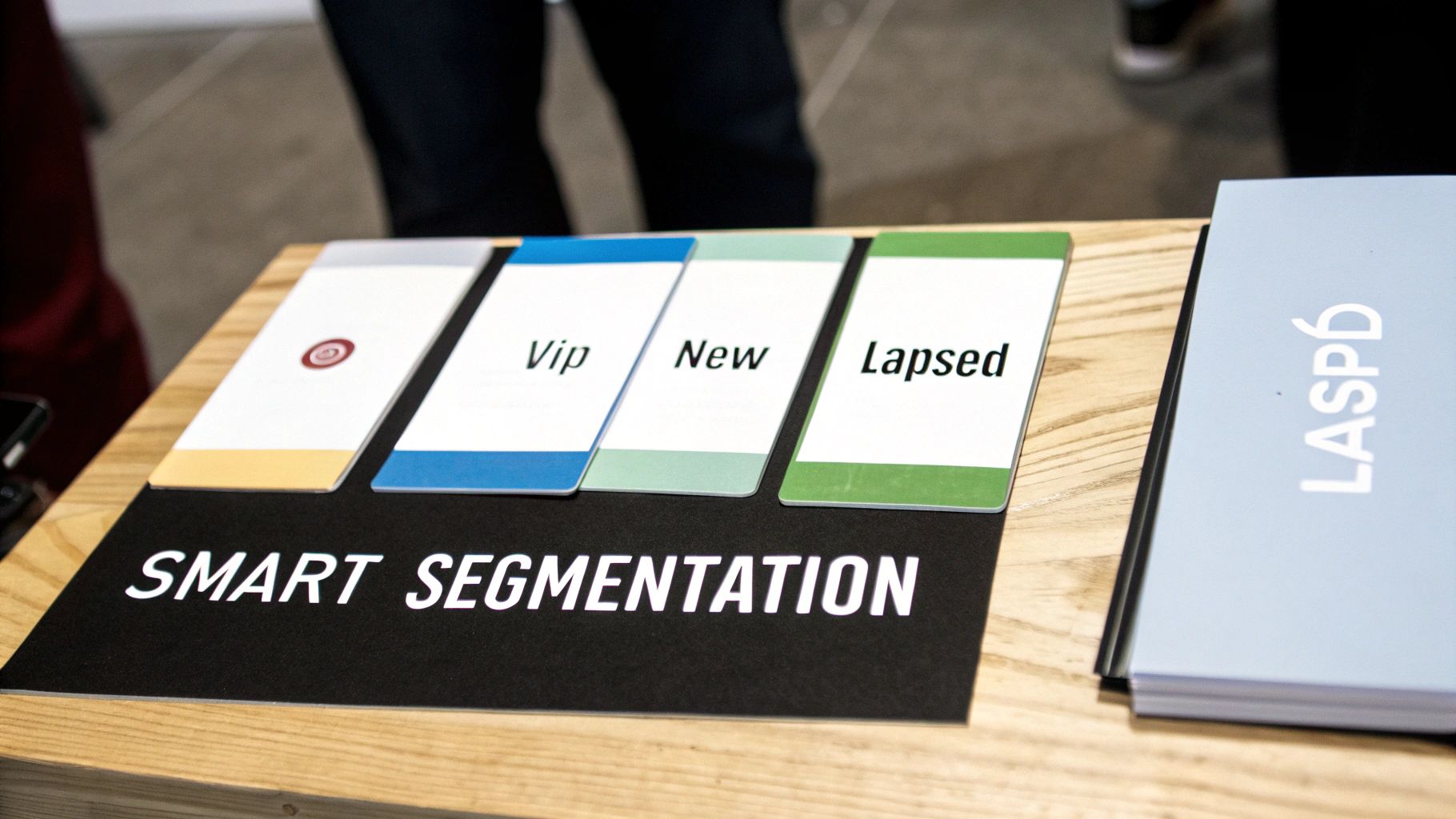
The most successful Shopify stores don't just have one email frequency—they have dozens. They know that sending the same number of emails to every single person is like handing out the same shoe size to every customer and just hoping it fits. It’s a recipe for disaster.
The secret to making your emails feel less like a megaphone and more like a personal conversation is smart segmentation.
This is really just the simple practice of slicing your total email list into smaller, more focused groups based on what they have in common. Instead of blasting your entire list with a flash sale, you can create a unique experience that respects each subscriber's relationship with your brand. And that's where you get to adjust your sending cadence for maximum impact.
For instance, hitting your VIP customers with a special offer three times a week could be wildly profitable. They already love your brand and are eager to hear from you. But sending that same volume to a brand-new subscriber? That just feels aggressive and is a one-way ticket to an unsubscribe.
Building Your Core Customer Segments
The real power here comes from creating segments that let you customize your email marketing frequency best practices. When you group subscribers based on their actions (or lack thereof), you can send them messages at a pace they’ll actually appreciate.
You can get started with just a few fundamental segments:
New Subscribers: These folks are just getting to know you. Your welcome series should hit their inbox at a higher frequency to build momentum and nudge them toward that all-important first purchase.
VIP Customers: These are your most loyal fans—the repeat buyers with a high lifetime value. This group will tolerate, and often welcome, more frequent emails about new products, sales, and exclusive perks.
Recent Purchasers: Someone who just bought from you needs post-purchase care, not another hard sell. Their emails should focus on order updates, product tips, and review requests, sent at a much lower frequency.
Lapsed Customers: This group hasn't opened an email or bought anything in a while. Bombarding them with daily promos is the fastest way to get marked as spam. A gentler, less frequent winback series is the right play here.
Segmentation ensures the right message hits the right person at the perfect time and at the perfect pace. It transforms your email frequency from a blunt instrument into a precision tool for driving revenue and building loyalty.
Think about it this way: your email frequency has to change depending on where a customer is in their journey. For an abandoned cart, that might mean an immediate reminder, followed by another touchpoint 12-24 hours later to maximize recovery without being annoying. The best merchants are constantly tweaking their cadence based on real-time engagement, purchase history, and even browsing behavior.
By applying these segmentation rules, you build a dynamic sending schedule that adapts to your customers, boosting engagement and keeping churn to a minimum. For a complete walkthrough, check out our guide on how to segment your email list for maximum growth.
So, How Do You A/B Test Your Email Sending Frequency?
While best practices give you a fantastic starting point, they aren't gospel. Every audience is different. The only real way to figure out the perfect sending rhythm for your customers is to test it methodically. Guessing can cost you real money or shrink your email list, but A/B testing takes all that guesswork out of the equation.
The concept is pretty simple. You take a slice of your audience, split them into two groups, and send them the same content—just at different intervals. Then, you sit back and measure what happens over a few weeks. This head-to-head comparison gives you undeniable, data-backed proof of what your subscribers actually want.
Setting Up Your Frequency Test
To get clean, trustworthy results, you need to be clear about what you're testing and who you're testing it on. I always recommend starting with a segment of your engaged subscribers. Why? Because you need feedback from people who are already paying attention to get a clear signal.
Here’s a simple plan any Shopify merchant can follow to get started:
Ask the Right Question: This is your hypothesis. Frame it clearly, like: "Will sending two newsletters a week to our engaged subscribers make more money than sending one, without making a ton of people unsubscribe?"
Split Your Audience: Create two equal, randomly selected groups from that engaged segment. Group A is your control—they'll keep getting the usual frequency. Group B is your variant—they'll get the new frequency you're testing.
Give It Time: You need to let the test run long enough to see real patterns, not just a one-day fluke. I find that three to four weeks is usually the sweet spot to smooth out any anomalies.
The point of A/B testing frequency isn't just about chasing opens or clicks. It’s about finding the sweet spot that drives your main goal—usually revenue—without burning out your email list for the long haul.
Measuring What Actually Matters
Once your test is over, don't get distracted by vanity metrics. You need to dig into the numbers that directly affect your revenue and the health of your list. For a deeper dive into the methodology, this comprehensive guide to A/B testing in marketing is a great resource.
Keep your eyes on these key performance indicators (KPIs) for each group:
Revenue Per Recipient (RPR): This is the big one for any e-commerce store. Which group made you more money per person?
Unsubscribe Rate: Did sending more emails cause a mass exodus? A tiny bump might be worth it if the revenue jump is big enough, but a major spike is a serious warning sign.
Click-Through Rate (CTR): Which sending schedule kept subscribers clicking and engaging with what you sent them?
By laying these numbers out side-by-side, you'll have a clear winner. This is how you move from guessing to knowing, turning raw data into a smarter, more profitable strategy.
Alright, let's put all this theory into practice. This is where the rubber meets the road—turning your email frequency strategy into a real, week-by-week sending schedule. Building a tangible plan helps you see exactly what your customers will experience, making sure your automated flows and one-off campaigns play nicely together in the inbox.
The idea is to create a rhythm. A predictable cadence builds anticipation and keeps your brand top-of-mind. You want your emails to become a welcome part of your customer's routine, not just another interruption. Think of it like choreographing a dance between your different email types.
Creating a Cohesive Calendar
For most Shopify stores, a weekly sending schedule hits the sweet spot. You don't want to be a ghost, but you don't want to be a pest either.
Recent data backs this up. Very few businesses (only 5.4%) email their lists daily. A much larger group—32.1% of marketers—lands in the sweet spot of four to eight emails a month. That’s roughly one or two emails per week. This frequency keeps you on their radar without overwhelming them, which is the core of smart email marketing. You can dig into more email marketing statistics on Databox.com if you're curious.
This structure lets you layer everything perfectly. Your automated emails, like cart abandonment and post-purchase follow-ups, are always running in the background, triggered by what your customers do. Your scheduled campaigns can then be slotted in around them.
A well-planned schedule is your safety net. It stops you from accidentally blasting a customer with a promotional newsletter an hour after they just abandoned their cart. Every single touchpoint feels intentional.
Sample Weekly Email Schedule
Here’s a blueprint you can steal and adapt for your own store. This example strikes a nice balance between selling and helping, creating a steady, welcome stream of communication.
Monday: A quiet day. Let your automated flows, like post-purchase emails, do the work after a busy weekend.
Tuesday: Time for a promotional newsletter. This is perfect for highlighting new arrivals or a special weekly feature.
Wednesday: Let the automations continue their work, engaging specific segments (like people who browsed a product but didn't add it to their cart).
Thursday: Shift gears to value. Share something useful, like a new blog post or a how-to guide that helps customers get more out of your products.
Friday: Kick off the weekend with a bang. Launch a sale or a special offer to drive conversions heading into Saturday and Sunday.
This kind of schedule gives you multiple touchpoints throughout the week without feeling spammy. It establishes a professional rhythm that both nurtures your customers and drives consistent revenue for your store.
Common Questions About Email Cadence, Answered
Finding the right email frequency can feel like walking a tightrope. Send too few, and you're forgotten. Send too many, and you're just noise. Here are the answers to the questions we hear most from Shopify store owners trying to find that perfect balance.
How Many Emails Is Too Many?
There's no single number that works for every brand, but your subscribers will tell you when you've gone too far. The two biggest warning signs are dropping open rates and a rising unsubscribe rate. If you see those two metrics moving in the wrong direction, you're probably hitting the inbox a little too hard.
Another major red flag? A jump in spam complaints. That’s your audience's way of saying "stop," and it's a signal you need to take seriously to protect your sender reputation. If you see a spike, it's time to ease off the gas for that group of subscribers.
Can I Send More Emails During the Holidays?
Definitely. In fact, you should. During big shopping seasons like Black Friday/Cyber Monday or the run-up to Christmas, people are actively looking for deals. They expect to hear from you more often. Ramping up your sending to announce flash sales or last-minute offers is a smart move.
The trick is to make sure every single email is packed with value. Keep a close eye on your engagement numbers. If you notice a dip, it might be a sign of fatigue, and you can pull back just a bit without losing momentum.
Should I Email Different Customer Groups at Different Rates?
Yes, 100%. This is where smart email marketing really shines. Your most loyal customers—the ones who open everything and buy regularly—will likely welcome more frequent emails about new arrivals or exclusive deals. They've opted in to being your biggest fans.
On the other hand, a brand new subscriber needs time to get to know you through a welcome series, and an old customer who hasn't purchased in a year needs a much slower, more strategic winback approach. Matching your sending frequency to the customer's journey is absolutely key.
This segmented strategy is all about relevance. You're not just blasting your whole list; you're having the right conversation, at the right pace, with the right people.
How Often Should You Send Marketing Emails: Conclusion
Ready to stop guessing and start growing? Email Wiz sets up your entire email marketing channel in seconds. With AI-powered automations for welcome series, abandoned carts, and weekly newsletters, you can recover more revenue and build customer loyalty—all on autopilot. Get started with Email Wiz today


Comments