Winback Email Examples for Ecommerce Brands: 5 Ideas to Re-Engage Lapsed Customers
- Sam Claren Fausto Dela Paz
- Mar 20
- 15 min read

Winback email examples are becoming essential reference points for ecommerce brands that want to recover lapsed customers and reactivate revenue from subscribers who have gone quiet. Re-engaging customers who have already purchased from the brand is significantly more cost-effective than acquiring new ones because they already know the brand, have experienced the products, and require far less persuasion to buy again. Brands that invest in well-designed, well-timed winback emails consistently recover meaningful revenue from their inactive subscriber base without spending a dollar on paid advertising.
Every ecommerce email list contains a segment of lapsed customers who were once engaged buyers but have stopped opening emails and making purchases. These subscribers represent a significant and often overlooked revenue opportunity because they have already demonstrated a willingness to buy from the brand at least once. Reaching them with the right message at the right moment is one of the most cost-efficient activities available to any Shopify marketing team.
In 2026, winback email strategies have evolved beyond simple discount offers and generic "we miss you" messages. Personalized product showcases, VIP exclusive offers, brand update emails, and honest last-chance communications are all proving highly effective at reactivating different types of lapsed customers. This guide explores five winback email examples with practical details that ecommerce brands can use to build a re-engagement program that consistently turns inactive subscribers back into active buyers.
Why Winback Emails Matter for Ecommerce Brands

Re-engaging lapsed customers is significantly more cost-effective than acquiring new ones because customers who have purchased before already know the brand and require far less persuasion than cold prospects. The cost of sending a winback email to an existing subscriber is minimal compared to the cost of running paid campaigns to find and convert entirely new customers. Brands that build an effective winback program consistently see strong returns from their inactive subscriber segments without increasing their overall marketing spend.
Lapsed customers also represent recoverable revenue that is sitting untouched on most brands' email lists. Every inactive subscriber was once interested enough to purchase from the brand, which means their original motivation to buy has not necessarily disappeared. It may simply need to be reactivated with a well-timed message that reminds them why they chose the brand in the first place.
Regularly re-engaging or removing inactive subscribers also helps maintain strong email deliverability metrics that benefit the entire program. A list full of inactive subscribers who never open emails signals to email service providers that the brand's content is not relevant, which can reduce inbox placement rates for active subscribers as well. Brands that run consistent winback campaigns protect their sender reputation and ensure that their active audience continues to receive emails reliably.
Customers who are successfully winback often become more loyal than those who never lapsed because the re-engagement experience reminds them of their original connection to the brand. A thoughtful winback email that makes a lapsed customer feel valued and remembered can create a stronger emotional bond than the original purchase experience alone. This renewed loyalty often translates into higher purchase frequency and increased lifetime value over the months that follow.
The Core Elements of a High-Performing Winback Email
Effective winback emails share several foundational characteristics that separate successful re-engagement campaigns from ignored ones. Understanding these elements helps ecommerce brands build winback emails that reach lapsed customers with the right message and the right motivation to return. Brands that get these fundamentals right consistently recover a higher percentage of their inactive subscriber base and generate stronger overall re-engagement program performance.
Personalized and empathetic opening
A personalized and empathetic opening acknowledges the lapse in communication in a warm and human way rather than launching immediately into a sales pitch or a discount offer. The opening should make the lapsed customer feel remembered and valued rather than targeted as part of a mass marketing campaign.
A well-crafted opening that references the customer's previous relationship with the brand creates an immediate emotional connection that generic promotional copy cannot replicate. Brands that lead with warmth and genuine acknowledgment of the customer's absence consistently see higher open rates and stronger re-engagement from their winback campaigns.
Compelling re-engagement incentive
A compelling re-engagement incentive is a discount, free shipping offer, exclusive product access, or added value that gives the lapsed customer a specific and meaningful reason to return to the brand. The incentive should feel proportionate to the length of the customer's inactivity and generous enough to overcome the inertia of disengagement.
The right incentive varies by brand and customer segment, but it should always feel like a genuine reward for returning rather than a desperate attempt to close a sale. Brands that match their winback incentive to the customer's previous purchase behavior and average order value consistently see stronger re-engagement rates than those using a one-size-fits-all approach.
Reminder of brand value and product quality
A brief reminder of what the brand offers and why the customer chose it in the first place reactivates the original brand affinity that motivated their initial purchase. This reminder is especially important for customers who lapsed due to distraction or life changes rather than genuine dissatisfaction with the brand.
Even a single sentence or a curated product image that reconnects the lapsed customer with their favorite products can meaningfully improve winback conversion rates. Brands that combine a re-engagement incentive with a clear reminder of their core value proposition consistently outperform those that lead with the offer alone.
Clear and low-friction call to action
A single prominent CTA that makes returning to shop as easy as possible by reducing the number of steps required to complete a purchase removes the friction that often prevents lapsed customers from acting even when they are motivated to return. The CTA should link directly to a relevant collection or pre-populated cart rather than the homepage to minimize the effort required.
Winback emails with a single focused CTA consistently see higher click-through rates than those with multiple competing options that create decision fatigue. Brands that make the path from email to purchase as short and frictionless as possible see the strongest conversion rates from their winback campaigns.
Winback Email Examples: 5 Ideas
Example 1: The "We Miss You" Discount Winback Email

A warm and personal "we miss you" message paired with a discount is one of the most consistently effective winback email formats across ecommerce categories because it combines emotional connection with a clear financial incentive. This format works because it acknowledges the lapse in a human and relatable way before presenting a compelling reason to return, which feels respectful and generous rather than transactional. Brands that lead with genuine warmth before introducing any offer consistently see stronger re-engagement rates than those that open directly with a promotional message.
Warm and personal opening message
A warm and personal opening message acknowledges the customer's absence without making them feel guilty or pressured, using language that feels like a genuine communication from the brand rather than an automated marketing email. The opening sets an emotional tone that makes the lapsed customer feel valued and missed rather than simply targeted for re-engagement.
In practice, a Shopify fashion brand might open their winback email with a subject line like "It has been a while, we have missed you" followed by a brief message expressing genuine appreciation for the customer's past support and a note that the brand wants to welcome them back with something special. This human and personal tone creates an immediate connection that makes the subscriber significantly more likely to read the rest of the email.
Compelling discount incentive
Pairing the warm opening with a specific discount offer gives the lapsed customer a clear and immediate financial reason to return and make a purchase. The discount should feel meaningful rather than token, which typically means at least 15 to 20 percent off or a free shipping offer for customers who have not purchased in three to six months.
A Shopify beauty brand might follow their warm opening with a 20 percent discount code exclusively for returning customers, framed as a personal welcome-back gift rather than a standard promotional offer. This combination of emotional warmth and tangible value consistently drives the strongest re-engagement rates of any winback format across most ecommerce categories.
Example in practice: A well-executed "we miss you" winback email from a Shopify clothing brand might feature a warm subject line, a personal two-sentence opening message, a prominently displayed discount code with a 7-day expiration, two or three product images from the current collection, and a single CTA button. The email should feel like a personal note from the brand rather than an automated campaign, leading with the customer relationship before any commercial messaging.
Example 2: The New Arrivals Winback Email
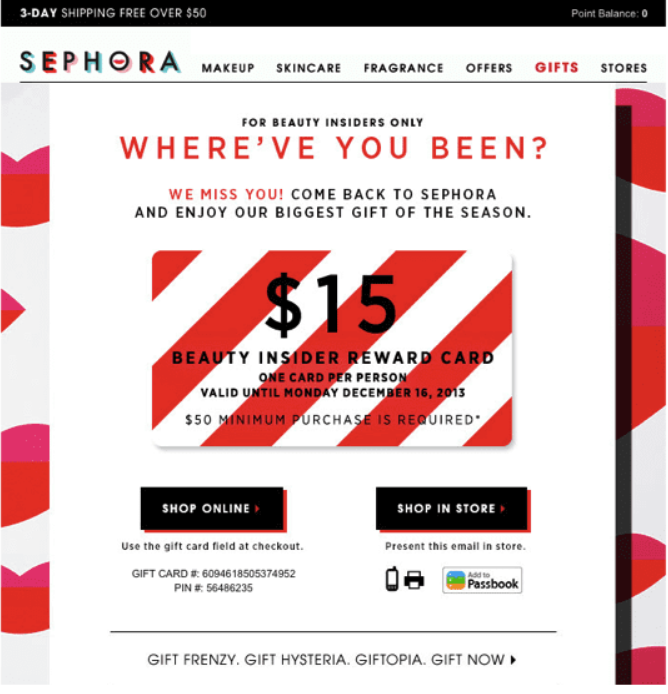
Showcasing new products and collection updates is an especially effective winback format for customers who may have lapsed simply because they felt the brand's offerings had not changed since their last purchase. This format works by reintroducing the brand as something fresh and worth exploring again, removing the assumption that the lapsed customer already knows everything the brand has to offer. Brands that use new arrivals as the primary winback hook consistently re-engage customers who did not respond to discount-based approaches.
New collection or product showcase
A new collection showcase features the brand's most exciting recent additions to remind the lapsed customer that the brand has continued to evolve and introduce compelling new products since their last purchase. This approach is especially effective for fashion, beauty, and lifestyle brands where novelty and newness are central to the purchasing motivation.
A Shopify lifestyle brand might send a winback email showcasing their latest collection with a bold headline like "A lot has changed since you last visited" followed by a curated selection of new arrivals with strong product photography. This fresh and visually compelling presentation gives the lapsed customer a genuine reason to return that goes beyond a discount code.
Personalized product recommendations
Recommending new arrivals based on the customer's previous purchase history makes the email feel individually tailored rather than a generic broadcast to the entire inactive segment. A lapsed customer who sees products that genuinely align with their demonstrated preferences is significantly more likely to click through and purchase than one who receives a generic new arrivals email.
A Shopify clothing brand might use purchase history data to recommend new arrivals in the same style category, size range, or color preferences as the customer's previous orders, opening the email with a line like "Based on what you loved before, we think you will love these." This personalized approach creates relevance and demonstrates that the brand remembers and values the individual customer's tastes.
Example in practice: An effective new arrivals winback email from a Shopify fashion brand might feature a bold subject line like "New arrivals we think you will love," a brief personal opening acknowledging the customer's absence, a curated grid of four to six new products with strong imagery and brief descriptions, and a single CTA linking to the full new arrivals collection. The email should feel editorial and inspiring rather than promotional, positioning the new products as a compelling reason to return rather than a sales pitch.
Example 3: The Exclusive VIP Winback Offer Email

Positioning the winback offer as an exclusive VIP reward rather than a standard promotional discount makes lapsed customers feel valued and significantly increases re-engagement rates by appealing to the desire for recognition and special treatment. This format works because it reframes the winback as a privilege rather than a generic marketing campaign, which creates a fundamentally different emotional response in the lapsed customer. Brands that use VIP framing in their winback emails consistently see stronger re-engagement from customers who are motivated by status and exclusivity rather than price alone.
VIP exclusive offer framing
A VIP exclusive offer presents the winback incentive as a special reward reserved for valued past customers rather than a discount available to anyone who visits the website. The framing should make the lapsed customer feel that their history with the brand entitles them to something that new or casual customers do not receive.
A Shopify wellness brand might send a winback email with a subject line like "Your VIP reward is waiting for you" alongside a message explaining that as one of their original customers, the subscriber has been selected for an exclusive offer that is not available to the general public. This positioning consistently drives stronger open rates and click-through rates than standard promotional language because it appeals to the customer's sense of being valued and recognized.
Limited availability or time-sensitive framing
Adding a deadline or exclusivity element to the VIP offer creates urgency alongside the sense of special treatment, giving the lapsed customer both an emotional and a practical reason to act within a specific window. The combination of feeling valued and knowing the offer will not last indefinitely is one of the most powerful motivators available in winback email marketing.
A Shopify supplements brand might communicate that the VIP offer is available for the next 72 hours only and is limited to a small group of their most valued past customers, creating a sense of genuine scarcity and urgency that motivates immediate action. This time-sensitive framing ensures that lapsed customers who open the email feel a clear incentive to act now rather than saving it for later.
Example in practice: A compelling VIP exclusive winback email from a Shopify wellness brand might open with a personalized subject line, feature a bold VIP banner at the top of the email, include a brief message explaining why the customer was selected for the exclusive offer, display a prominent discount code with a clear expiration date, and close with a single CTA linking to a curated collection. The email should feel premium and personal rather than mass-marketed, reinforcing the customer's sense of being a valued and recognized part of the brand community.
Example 4: The "Here Is What You Missed" Winback Email

A curiosity-driven winback email that highlights what the brand has been up to since the customer's last purchase is especially effective at reactivating customers who lapsed due to distraction or life changes rather than dissatisfaction with the brand. This format works by creating a sense of FOMO around the brand's evolution and making the lapsed customer feel that they have missed out on exciting developments they would have enjoyed. Brands that use this approach consistently re-engage a segment of lapsed customers who did not respond to discount or VIP-based winback attempts.
Brand updates and milestones
Sharing exciting brand developments, new product lines, awards, or community milestones since the customer's last purchase reminds them that the brand is thriving and continues to be worth their attention and loyalty. This type of content reactivates the customer's original pride in supporting the brand and their curiosity about what it has become.
A Shopify beauty brand might send a winback email sharing that they have launched three new product lines, earned recognition from a respected industry publication, and grown their community to a significant new milestone since the customer last visited. This update creates genuine excitement and curiosity that motivates the lapsed customer to see what else has changed since their last interaction with the brand.
Customer favorites and bestsellers
Highlighting the products that have become customer favorites and bestsellers since the lapsed customer's last visit creates FOMO around what they have been missing and rekindles purchase interest through social proof. Seeing that thousands of other customers have discovered and loved specific products since their last purchase creates a compelling reason to return and explore.
A Shopify home goods brand might feature a section in their winback email titled "What everyone has been buying while you were away" showcasing their three most popular products with review counts and star ratings. This social proof-driven approach combines FOMO with credibility in a way that motivates lapsed customers who are influenced by what others are purchasing and enjoying.
Example in practice: An effective "here is what you missed" winback email from a Shopify skincare brand might open with a subject line like "A lot has happened since you last visited," feature a brief brand update section with two or three milestone highlights, follow with a bestseller showcase with customer review counts, and close with a CTA inviting the lapsed customer to explore what is new. The email should feel exciting and forward-looking rather than nostalgic, positioning the brand as something worth returning to rather than something from the past.
Example 5: The Last Chance Winback Email

A final last-chance winback email that clearly communicates the subscriber will be removed from the list unless they take action is one of the most effective re-engagement tools for customers who have not responded to earlier winback attempts. This format works because the prospect of being removed from the list creates a sense of finality that motivates action from subscribers who have been ignoring previous emails out of inertia rather than genuine disinterest. Brands that send a well-designed last-chance winback email consistently see a meaningful spike in re-engagement from their most inactive subscribers before removing them from the list entirely.
Honest and direct communication
Clearly telling the subscriber that they will be removed from the list unless they take action frames the email as a respectful acknowledgment of their preferences rather than a threat or an aggressive retention tactic. The message should feel honest and considerate, making it clear that the brand respects the subscriber's time and inbox rather than holding them hostage on a list they no longer engage with.
A Shopify fashion brand might send a last-chance email with a subject line like "Should we say goodbye?" followed by a brief message explaining that the subscriber has not engaged in some time and that the brand will remove them from the list unless they choose to stay. This honest and human approach consistently generates a stronger response than aggressive promotional language because it treats the subscriber as an adult who deserves transparency.
One final compelling offer
Pairing the last-chance message with the strongest possible re-engagement incentive gives unresponsive subscribers every reason to engage before being removed from the list. The final offer should be more generous than any previous winback incentive to signal that the brand genuinely wants the customer back and is willing to make a meaningful gesture to keep the relationship alive.
A Shopify skincare brand might pair their last-chance message with a 30 percent discount code and a free sample product on their next order, making the final offer the most compelling in the entire winback sequence. This combination of honest communication and genuine generosity consistently recovers a percentage of subscribers who ignored all previous winback attempts and would otherwise be permanently lost.
Example in practice: An effective last-chance winback email from a Shopify supplements brand might feature a simple and human subject line, a brief and honest two-sentence message explaining that the subscriber will be removed unless they choose to stay, a bold final offer with a 48-hour expiration, a clear "Keep me subscribed" CTA button, and a secondary link allowing the subscriber to unsubscribe if they genuinely prefer to leave. The email should feel respectful and genuine rather than dramatic, giving the lapsed customer a clear and easy choice between re-engaging and parting ways gracefully.
How to Automate Your Winback Emails with the Right Tools

Winback emails are only effective when they are triggered automatically based on defined periods of customer inactivity rather than sent manually on an ad-hoc basis. Manually identifying lapsed customers, segmenting them by inactivity period, and sending targeted re-engagement emails at scale is impractical for any team managing a growing Shopify store. The only practical solution for running a consistent and scalable winback program is an automated flow that triggers based on customer behavior and runs continuously in the background.
The connection between customer inactivity detection and automated winback delivery is where many Shopify brands leave significant recoverable revenue untouched. Many stores are aware that they have lapsed customers but lack the automation infrastructure to reach them consistently and at the right moment in their disengagement cycle. A well-configured winback flow that triggers automatically after a defined period of inactivity is consistently one of the most revenue-efficient automations in any ecommerce email program.
Wiz represents one example of a platform that simplifies this setup entirely for Shopify brands. It automatically installs a customer winback flow the moment the app is set up on Shopify, without requiring any manual configuration, audience building, or copywriting from the store owner. For Shopify brands that want their winback program running immediately and recovering lapsed customer revenue from day one, that kind of automated setup removes the most common barrier between an inactive list and a re-engaged customer base.
Frequently Asked Questions
What is a winback email and when should it be sent?
A winback email is an automated re-engagement message sent to subscribers who have stopped opening emails or making purchases after a defined period of inactivity. It should be sent when a customer has been inactive for 60 to 90 days, while their memory of and connection to the brand is still fresh enough to motivate re-engagement.
How long should a customer be inactive before receiving a winback email?
Most ecommerce brands trigger their first winback email after 60 to 90 days of customer inactivity, depending on the typical purchase frequency of their category. Brands with higher purchase frequency categories, like supplements or beauty, may trigger winback earlier, while those with longer purchase cycles may wait slightly longer before initiating the sequence.
What incentive works best in a winback email?
The best winback incentive depends on why the customer lapsed and what motivated their original purchase, but a combination of warm personal messaging and a meaningful discount or exclusive offer consistently performs well across most ecommerce categories. Testing different incentive types, including new arrivals showcases, VIP offers, and discount codes, helps brands identify what resonates most with their specific inactive audience.
How do you avoid sounding desperate in a winback email?
Avoiding desperation in a winback email comes from leading with genuine warmth, customer appreciation, and brand value rather than aggressively pushing an offer or using urgent language that feels manufactured. A tone that respects the customer's autonomy and treats the re-engagement as an invitation rather than a demand consistently generates stronger responses than pressure-driven messaging.
What tools help automate winback emails for Shopify stores?
Platforms such as Wiz provide robust automation tools for building and scheduling winback flows based on customer inactivity triggers. AI-driven platforms like Wiz take this further by automatically installing a complete customer winback flow the moment the app is set up on Shopify, ensuring that every lapsed customer triggers an automated and on-brand re-engagement sequence without any manual configuration required.
Conclusion
Winback email examples are essential reference points for any ecommerce brand that wants to recover lapsed customers and reactivate revenue from an audience that already knows and has purchased from the brand. The combination of lower acquisition costs, recoverable purchase intent, and the potential for renewed long-term loyalty makes winback email marketing one of the most financially compelling programs any Shopify brand can have running in the background. Brands that invest in a well-structured and consistently executed winback program consistently see meaningful increases in customer lifetime value and overall email program revenue.
However, manually identifying lapsed customers, segmenting them by inactivity period, and sending targeted re-engagement emails at scale is impractical for growing Shopify brands managing multiple priorities simultaneously. The most effective winback programs are fully automated, triggering based on customer inactivity and running the complete re-engagement sequence without any manual involvement from the team. This is where automation becomes not just convenient but genuinely essential for capturing the full revenue potential of every lapsed customer on the list.
AI-powered platforms are beginning to transform how Shopify brands approach their customer winback programs. Tools like Wiz automatically install a complete winback flow the moment the app is set up, ensuring that every lapsed customer triggers an immediate, on-brand, and revenue-focused re-engagement experience without any manual configuration. For Shopify brands looking to turn their inactive subscriber base into a consistent source of recovered revenue, automated winback tools represent the most efficient and effective path forward. Visit https://www.emailwiz.ai/ for more details.


Comments